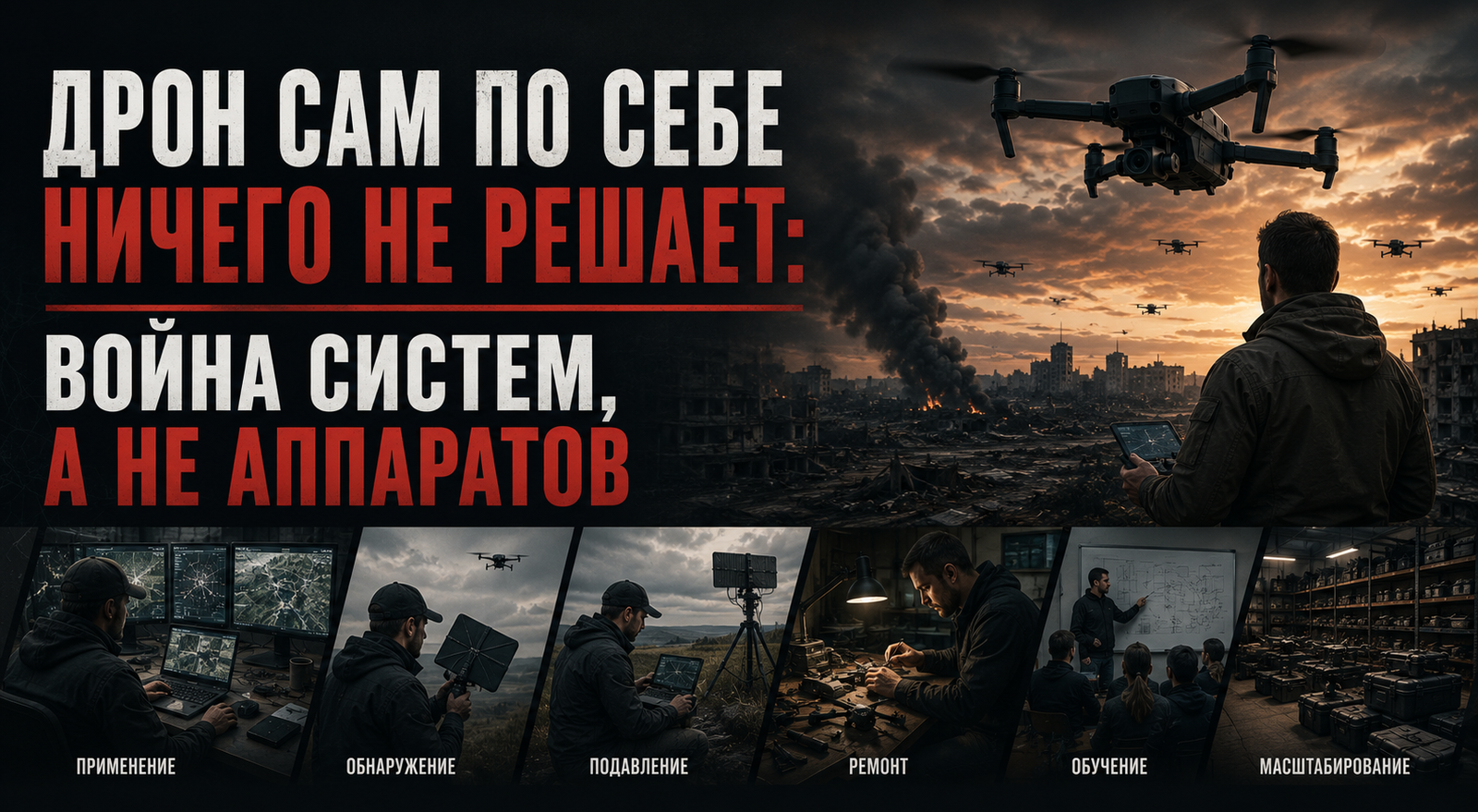
The fundamental fallacy in contemporary discourse surrounding drones is the perception of these systems as standalone wonder-weapons. The prevailing discussion fixates on range, optical capabilities, payload capacity, cost, communication protocols, operational endurance, velocity, and airframe design. While these metrics possess undeniable relevance, they remain secondary.
The formula dictates otherwise: a drone, in isolation, resolves nothing. The true arbiter is the integrated system of deployment, detection, suppression, maintenance, training, and scaling. A drone without an operator is merely an inert artifact. Without connectivity, a lost asset. Without maintenance, a single-use expendable. Without proper training, a costly miscalculation. Without reconnaissance, a sightless instrument. Without an adversary suppression system, an exposed vulnerability. Without scalability, a localized incident rather than a strategic imperative.
The new war is not a competition of discrete units. It is a competition of systems capable of producing, employing, losing, regenerating, adapting, and re-employing unmanned assets faster than the adversary.
Why the Cult of 'Drone as a Thing' is Perilous A drone is not merely a 'thing' to be acquired from a retail outlet, like a Garmin timepiece or a Leica camera. It is not a toy, a gadget, nor a fashionable accessory. A drone is an instrument. An instrument capable of both creation and destruction. An instrument which, upon entering human hands, becomes an extension of their will, their intent, their ethics. The cult of 'drone as a thing' constitutes a perilous fallacy, leading to an underestimation of its true potential and, consequently, to flawed security decisions. This mindset disregards the operational dimension of the drone: its capacity for autonomous action, its integration into complex systems, its potential as a vector for reconnaissance, surveillance, targeting, and even kinetic engagement. A 'thing-centric' mindset fixates on technical specifications, price point, and aesthetic design. It critically overlooks the core truth: a drone is not merely an object; it is a subject capable of impact, of altering reality. It is not a passive instrument, but an active actor within the operational environment. It is precisely this fallacy, this 'thing-centric' approach, that leads to drones manifesting in the hands of criminals, terrorists, and unscrupulous competitors. We witness their deployment for contraband smuggling, espionage, sabotage, and direct assault. And each instance is met with feigned astonishment: "How could this have happened? It's merely a drone!" Yet, a drone is never 'merely a drone'. It is a potential weapon system, a vector for surveillance, an instrument of influence. It demands commensurate treatment, with a profound understanding of its true nature and its critical position within the security architecture. We must transition from a 'thing-centric' mentality to an operational one, from a consumerist attitude to a strategic imperative. We must cease perceiving the drone merely as a commodity and begin to recognize it as a critical component within a complex, dynamic system, demanding rigorous analysis, predictive modeling, and proactive risk management. Otherwise, we risk finding ourselves in a scenario where technologies engineered for progress are weaponized against us, and our own collective ignorance becomes our paramount adversary. As posited by Spiridonov, and later elaborated upon by Undeutsch, the bedrock of any effective security system lies in a profound comprehension of human psychology and its interaction with instrumentation. To disregard this principle concerning drones is to chart a course toward catastrophe.
Military and politicians favor simple symbols: the tank, the missile, the aircraft, the ship, the drone — all readily displayed as emblems of force. Yet, the drone cannot be understood through the logic of parade hardware. Its potency lies not in its chassis, but in the operational contour into which it is integrated.
A drone is not merely an aerial platform; it is a critical node within an overarching system. It is inextricably linked to the operator, the operational unit, intelligence assets, communication infrastructure, manufacturing, repair, software architecture, electronic warfare, logistical frameworks, training cadres, and the command hierarchy. Should this operational nexus be compromised, even a high-spec drone fails to generate a decisive advantage. Conversely, a robust nexus transforms even a rudimentary platform into a critical component of substantial military success.
The question 'which drone is superior' is secondary. The primary question is distinct: which system more swiftly operationalizes a drone for combat action?
The Six Architectures of Power
Application.A drone must be intrinsically woven into the operational matrix, not merely a free-floating sensor. Its function must be precisely delineated: observation, route validation, tactical adjustment, escort, logistical conduit, communication relay, perimeter integrity, engineering reconnaissance, unit support. The operational framework dictates the command nexus: who tasks, who controls, who receives intelligence, who holds decision authority, how data is transmitted and forensically captured, how anomalies are dissected, and how lessons are integrated into the adaptive learning matrix. Absent these foundational parameters, the drone degrades into an operator's digital bauble — capable of delivering aesthetic spectacle, yet yielding zero strategic advantage. The authentic drone system emerges only when every single flight is an integral node within the iterative decision cycle.
Detection.The drone war isn't merely about deploying your own assets; it's about the relentless capacity to perceive the enemy's. The micro-aerial threat has fundamentally reshaped the very concept of defense: once, a target was defended against human intrusion, vehicles, artillery barrages, conventional aviation, or guided missiles. Now, defense must contend with a cheap, diminutive, and rapidly evolving platform, manifesting precisely where legacy systems are blind. Detection isn't a singular radar sweep or a lone pair of eyes; it's an interwoven stratum of systems: visual surveillance, acoustic sensors, radio frequency spectrum monitoring, advanced optics and thermal imaging, distributed local observation posts, aggregated intelligence from operational units, seamless interoperability between civilian and military agencies, and a rigorously defined alert transmission protocol. The critical question isn't the theoretical possibility of drone detection, but the temporal delta between threat manifestation and actionable command decision. Detected too late, the system has already forfeited time. Information untransmitted, the system has forfeited its connectivity. No authority to act, the system has forfeited control.
Suppression.A drone must not be viewed solely as an offensive instrument; every drone revolution immediately spawns a counter-drone equivalent. A perpetual conflict rages: drone versus electronic warfare, operator versus jamming, concealment versus optics, decoys versus algorithms, rapid repair versus attrition, new frequency versus suppression, new route versus detection, new tactics versus obsolete doctrine. Suppression transcends mere technology; it is a discipline of counter-engagement. The system must comprehend: the adversary, too, learns, analyzes losses, alters decisions, seeks vulnerabilities, probes reactions, and devises new stratagems. The drone conflict is a crucible of adaptation, not a mere duel of apparatus.
Restoration.In the archaic doctrines of warfare, maintenance was merely a logistical afterthought, a rear-echelon function. In the era of drone warfare, however, it morphs into an integral component of the combat cycle. Unmanned systems are expended en masse: they fail, are lost, sustain damage, demanding constant part replacement, firmware updates, communication recalibration, and even structural modifications. An army solely optimized for procurement remains tethered to the depot, vulnerable to supply chain disruptions. Conversely, a force adept at localized, in-situ repair gains critical operational resilience. Its mandate is to ensure that attrition does not cripple the system: a damaged unit either returns to service, yields salvageable components, or provides crucial telemetry for iterative improvement of subsequent batches. In this critical sense, repair functions as a potent form of operational intelligence: it illuminates prevalent failure modes, environmental tolerances, inherent component weaknesses, and the systemic design revisions required.
Operational Induction.The drone mandates not merely piloting skill, but a novel operational literacy. The operator must possess the capacity to perceive aerial topography, interpret visual data, discern adversary patterns, enforce communication discipline, operate under duress, differentiate raw data from subjective interpretation, and articulate intelligence with precision. The commander, in turn, must comprehend the drone's operational envelope and inherent limitations – knowing when to validate visual feeds, when to mandate corroboration, when to recalibrate strategic vectors, and when to enforce tactical stasis. The operational cell must internalize that the drone functions as an organ of collective vision, not merely an individualized specialist's asset. Crucially, perpetual operational re-calibration is paramount: a six-month-old doctrine risks obsolescence, and yesterday's tactical edge will degrade into a predictable pattern an adversary has already reverse-engineered. Triumph is not secured by initial operator indoctrination, but by the capacity to re-architect the operational system at a velocity exceeding the adversary's adaptive cycle.
Scaling.A single skilled operator can win an engagement; a strong group can forge a localized success. But strategic advantage only emerges when experience becomes mass-scale—when a successful technique transforms into a standard. This necessitates production capabilities, repair facilities, instructors, unified protocols, feedback channels, rapid component procurement, agile design modifications, frontline-to-industry liaison, organizational and legal frameworks, and supply chain security. A system that fails to scale experience starts from zero every time—while an adversary capable of scaling transforms isolated success into a mass-scale norm.

Drone System: Recursive Loop
The drone system functions not as a linear progression, but as a recurring operational cycle: identify the objective, deploy the asset, acquire intelligence, execute a decision, implement the action, assess the outcome, suffer asset attrition or achieve recovery, initiate remediation, conduct post-mortem error analysis, recalibrate the methodology, update operator protocols, and scale validated solutions.
This, then, is the true operational unit of drone warfare — not the hardware, nor the model designation, nor the procurement tranche, but the operational tempo. A rapid operational tempo: the system lives. A protracted operational tempo: the system becomes obsolete even as the conflict unfolds.
Ukraine: The Drone Warfare Crucible
Ukraine has emerged as a prime exemplar of the nascent drone reality, due to the conflict's imperative to fuse front-line operations, manufacturing, training, maintenance, and feedback into a singular, integrated circuit. This crucible revealed a fundamental axiom: that drone supremacy is not forged in the sterile isolation of a laboratory, detached from the theatre of war, but rather within the relentless, iterative nexus between combat experience and systemic evolution.
The front dictates; production responds. An operator flags an issue; an engineer re-architects the solution. An instructor recalibrates the doctrine; a unit deploys the revised protocol. The adversary adapts. The cycle recommences. This is not the comfortable innovation of peacetime; this is brutal, high-pressure iteration. This is precisely why the Ukrainian operational paradigm holds significant interest for Europe, NATO, and nations currently grappling not merely with "which drones to procure," but with the foundational architecture of a comprehensive drone ecosystem.
The Silo Mentality Fallacy
The most dangerous fallacy is to treat drones merely as inventory: how many acquired, how many deployed, how much capital earmarked, how many models formally adopted. Yet, this inventory-centric mindset fails to address the core inquiry —How much kinetic output does this entire technological mass actually manifest?One can procure a multitude of apparatus and invite chaos: disparate models, incompatible components, inconsistent training levels, precarious maintenance, fractured connectivity, and an analytical void. The depot may swell, but the system remains critically vulnerable.
Correct thinking is systemic. It interrogates: how swiftly the apparatus deploys to the operational unit, how rapidly the operative achieves full operational proficiency, how promptly hardware is remediated, how fluidly protocols are reconfigured, how decisively vulnerabilities are exposed, and how efficiently experience crystallizes into a new operational standard.

The Drone: An Exam for the State
Drone warfare is not merely a crucible for the armed forces; it is an unforgiving audit of the state itself. It exposes the operational integrity of its systems: the capacity for agile procurement, the efficacy of private sector integration, the resilience of supply chain fortifications, the engineering of adaptive training protocols, the iteration of regulatory frameworks, the synthesis of front-line imperatives with industrial output, the processing of systemic failures, and the scaling of validated solutions.
A drone is small, yet it cracks open a vast system. Sometimes, a diminutive apparatus reveals a state's lethargic bureaucracy, anemic industrial coordination, a ruptured nexus between military forces and manufacturers, obsolete protocols, and a profound reluctance to iterate. Consequently, the drone is not merely battlefield ordnance, but a systemic diagnostic instrument.
Drones: Critical Infrastructure Under Aerial Scrutiny
This same operational logic governs the defense of critical infrastructure. A power station, a port, an aerodrome, an an oil depot, a rail nexus, or a nuclear facility cannot be secured by mere perimeter fencing and static guard deployment. What is mandated is an integrated system encompassing low-altitude aerial threat detection, real-time signal relay, calibrated decision-matrix protocols, a defined legal response regime, dynamic technical interdiction capabilities, post-incident forensic analysis, rigorous personnel training, and adaptive procedural recalibration.
An entity that fails to learn from each incident becomes a convenient target for repeated probing. The modern asset's true perimeter does not commence at the physical gates, but rather with its aerial, informational, and procedural boundaries.

The Principal Conflict of the Coming Age
The primary conflict of the future is the conflict between apparatus and system. Feeble intellect seeks "the best drone" — robust intellect engineers a superior deployment system. Feeble intellect trusts procurement — robust intellect calculates the lifecycle. Feeble intellect fears apparatus attrition — robust intellect transmutes losses into data. Feeble intellect drafts an instruction once — robust intellect perpetually updates its learning schema. Feeble intellect constructs a showcase — robust intellect cultivates an ecosystem.
The Drone Maturity Formula
The true drone maturity of an army or a state is not measured in the sheer volume of its aerial assets, but in the systemic integrity of six core operational vectors: deployment, detection, suppression, maintenance, training, and scalability.
Should even a single element be compromised, the entire system is weakened. Deployment without detection — the system is blind to anything beyond itself. Drones exist, but suppression is absent — the adversary moves unimpeded. Procurement without repair — losses metastasize into catastrophe. Operators exist, but training is absent — expertise remains static. Effective solutions manifest, but scaling is absent — success remains an isolated incident.
True power resides not in the mere accumulation of drones, but in the cognitive architecture capable of weaving them into a responsive, living system.
Conclusion: The Drone as a Shaping Force in the Emergent Military Culture
A drone, in isolation, is a void of intent. Its operational efficacy, its very purpose, materializes solely when integrated into a comprehensive architecture – one that perceives, processes, executes, self-heals, learns, and scales. This stands as the cardinal axiom of contemporary conflict.
A drone is not a wonder-weapon, but a system accelerator. If the system is intelligent, it amplifies it. If the system is inept, it accelerates its errors.
Therefore, the future's critical inquiry isn't merely 'who fields more drones,' nor even 'whose drones are superior.' The paramount question is whose *entire* drone ecosystem — from detection to training, from maintenance to scalable deployment — operates with greater velocity and intelligence. It is precisely this integrated system, not the isolated apparatus, that crystallizes as the true armament of the 21st century.


