
Navigational anthropology
The Invisible Code of the Metropolis
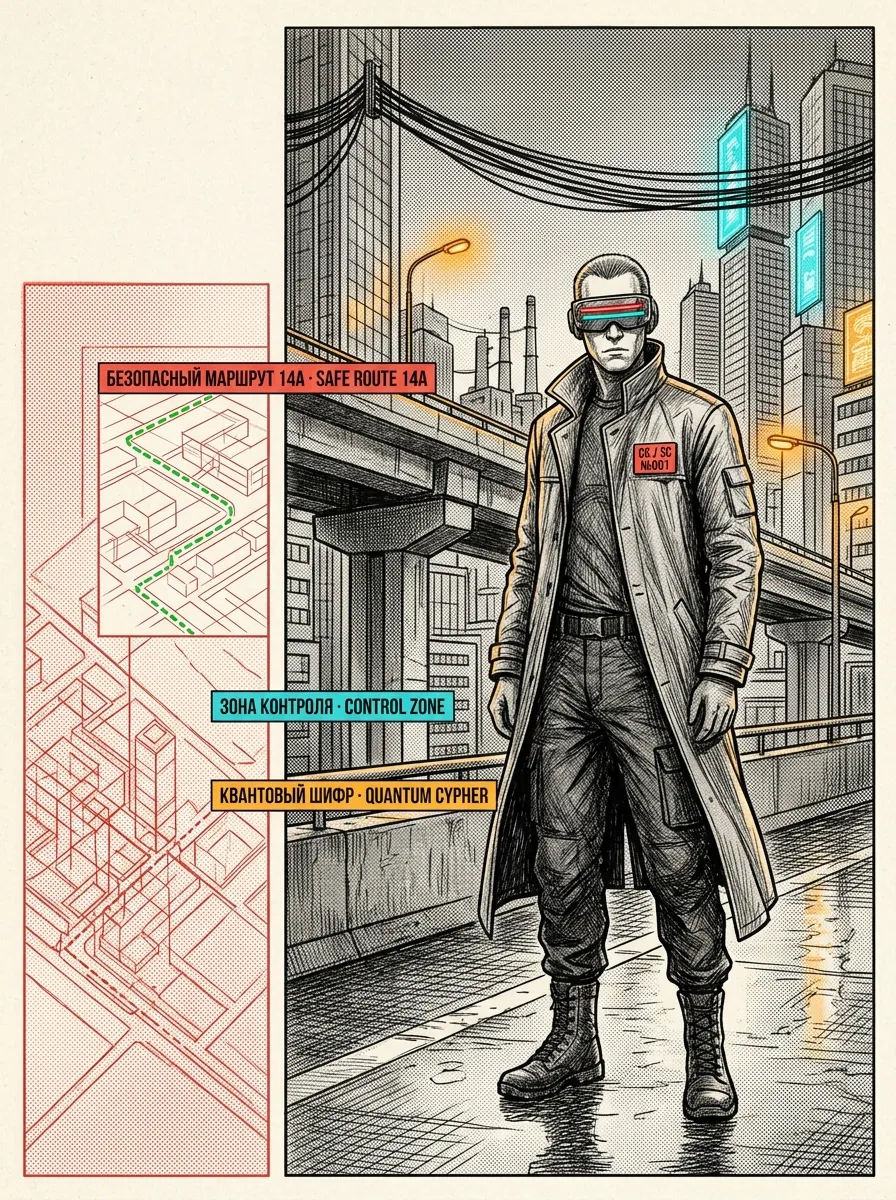
We study the city to survive in it. Routes, shadows, blind spots — an anthropology of movement in the era of the quantum cypher. The lead spread of issue №1.
We study the city to survive in it. Routes, shadows, blind spots — an anthropology of movement in the era of the quantum cypher. The lead spread of issue №1.

Алгоритмы обхода предиктивного надзора. Поведенческий слепок, читаемость как уязвимость, управляемая аритмия — технология выхода из модели.

Где заканчивается алгоритм и начинается интуиция. Репортаж из автоматизированного сектора «Омега»: туман, отказ техники, три оператора.

USA, Europe, Ukraine: markets diverge in growth, but the operational imperatives, across all vectors, accelerate beyond the reach of extant training protocols.

Стойка Sanchin-Dachi, инверсии ТРИЗ и motion-capture: тело как инструмент навигации в плотном городском паноптиконе.

A situation in which the move has already been chosen for you. A dispatch from an observation post that has no interests of its own.

Будущее персональной безопасности в эпоху тотальной цифровой прозрачности. Подозрение как вероятность, поведенческие метаданные, deepfake и война за подлинность.

Тактические носимые системы как внешняя нервная система: как Garmin MARQ и Instinct Tactical сжимают реакцию с 0,25 сек до 1 мс.

A house in which people spoke in a whisper

Testimony under the microscope: a method that changes the interrogation

Why do states and corporations identically lose ground — by failing to detect emergent fissures in time?

Why in the twenty-first century we have ended up defenceless where any child once coped, and what to do about it

A programme statement of the Institute for Special Engineering: navigation, not walls; resilience, not fortresses; cognitive reach, not paranoia.

The urban environment changes faster than we can map it. A route that was safe yesterday today falls into a grey zone: camera optics, drone paths, behavioural triggers of algorithms — all of this quietly redraws our daily walk home.
In the editorial office we spent the winter watching how perimeter operators learn to read those who read them. The anthropology of movement is about body language, about pace and about the gaze that does not look down.
Route 14A is one of the few that has no official name and is not indexed by any navigator. It is known to couriers, pneumatic-mail dispatchers and to those who work the night shift on the northern industrial ring.
The risk map you see on the facing page is a snapshot of a single December night. By morning the configuration of zones had already shifted: the algorithm reallocated attention, and Route 14A became safe again — for six hours and seven minutes.
Today we don’t study the city as a geographer. We study it the way a hunter studies the forest: not by the map, but by the tracks, by the smell, by the thin signals that only a trained ear can hear.
“A safe route is not a line on a map but a contract with the invisible infrastructure of the city.”— A. Meshcheryakov

WE STAND ON THE THRESHOLD of an era when reaction time will be measured not in seconds but in milliseconds. The classical problem of security has always been latency — the operator sees the threat too late.
«We don’t follow people», explains the lead engineer. «We follow vectors. When the vector deviates from the corridor by more than 0.4 sigma, the system raises an alarm — long before a human reads body language.»
The grid does not store faces. It stores micro-deltas of pace, of pulse, of turn-of-shoulder. Behind every alarm lies an integral of historical context, weighted by sector reliability.
“A threat is not an event. It is a sequence of small anomalies that the eye fails to add up.”
| Phase | Human | Neural grid |
|---|---|---|
| Detection | 1.2–2.5 сек | 0.04 сек |
| Analysis | 5.0–15.0 сек | 0.12 сек |
| Action | 3.0–10.0 сек | мгновенно |
The final synthesis of the issue. We overlay neural-grid data onto the topographic reality of Bavaria — Siemens HQ, BMW Werk, the Munich Security Conference contour. A closed loop of a quantum panopticon.

| Sector | Risk | Scan density | Recommended protocol |
|---|---|---|---|
| Harbour Hub | Extreme | 98% (total) | Ghost Fight + mimicry |
| Historical Center | High | 65% (hybrid) | Navigational anthropology |
| Industrial Belt | Medium | 30% (passive) | Active SIGINT suppression |
| Residential | Low | 15% (social) | Digital hygiene |
“Security is not a wall. It is navigation. We teach you to read the city as a map of risks and possibilities.”— SC Editorial
Every city offers each citizen a line of credit — a feeling of safety paid for in privacy, taxes and KYC. We made this contract explicit. Below is the integral SC editors use to weigh real perimeter resilience.
We need those who see code in chaos. Those who understand that security is not a wall but a process. Not a fortress but a quiet, watchful navigation through fog, drift and noise.
The journal Security Credit is the manifesto of the Institute for Special Engineering. We connect criminology, physics, urban anthropology and quantum protocols into a single discipline — and we publish it on warm paper, with grain and red ink.
If you read these lines, the contract is signed. Welcome to the laboratory.


