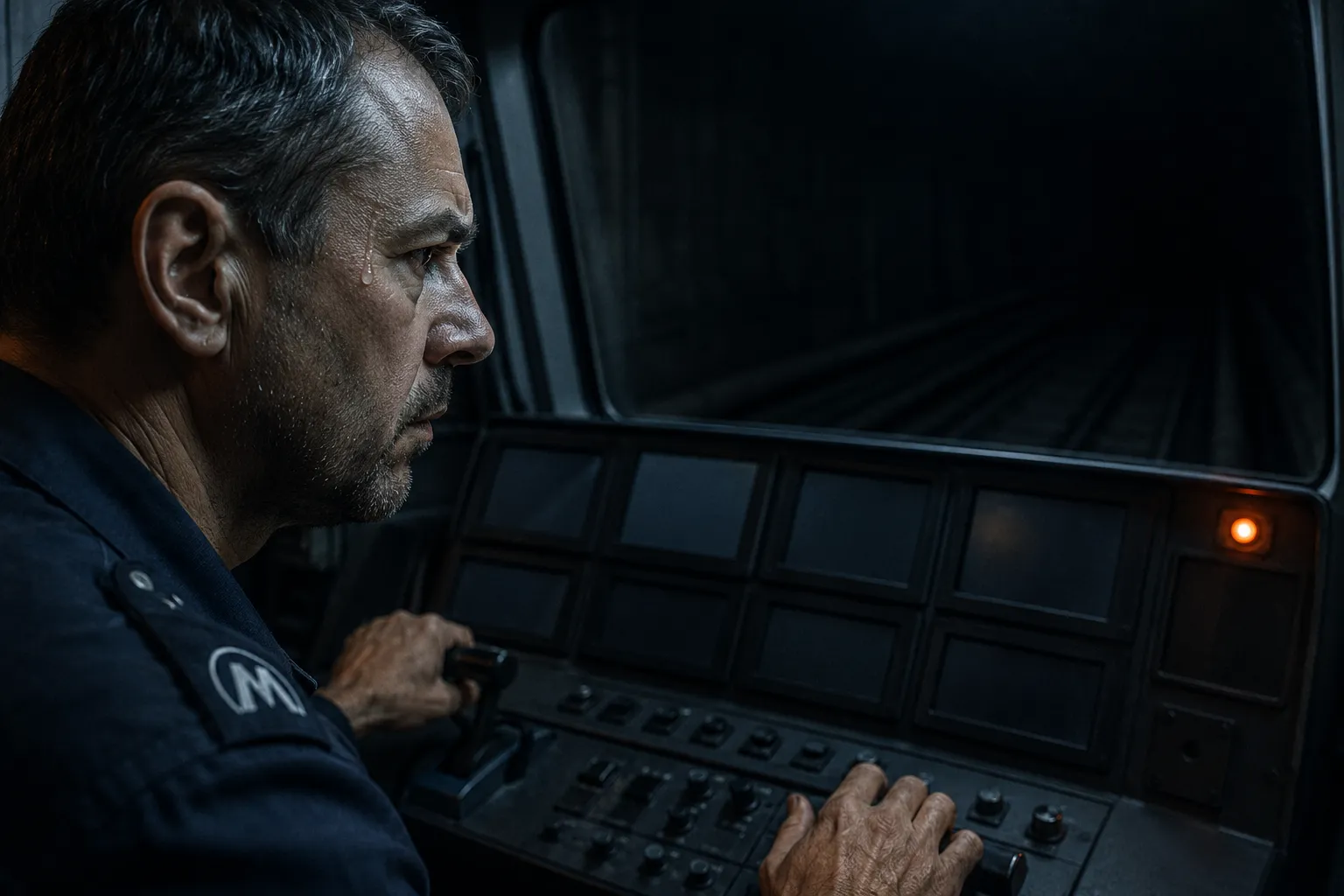

Six thirty-eight in the morning. A metro train is in transit between two stations. Nothing portends trouble. And at this moment eight screens go dark on the control panel simultaneously.
A driver with twenty years of experience — let us call him Sergey Petrovich — would later tell the investigator that for the first two seconds his hands gave way. Not from fear. From the novelty of the sensation. In twenty years of work he had not once seen his control panel like that. All the autoblock systems, all the speed indicators, all the contact-rail current sensors — dead. The train rolls on by inertia, the tunnel is dark, the nearest station is four hundred metres away, an oncoming train may be on the opposite track, and Sergey Petrovich, for the first time in his life, finds himself in conditions in which no one has ever taught him how to act.
More precisely — they had taught him. In courses at the training centre, twenty years ago, when he had just joined the depot. Then, in the eighties, there were still instructors who made every young driver pass the procedure of "manual driving with full automation failure". They were called the old men — and they were old men, who remembered the days when the metro was driven eighty per cent by hand. Sergey Petrovich passed the exam on this procedure at twenty-two and never returned to it. For twenty years he drove the train under conditions in which he did not need to think: the automatics did everything for him.
That morning in the tunnel he tried to recall the instructions. He did not recall them. Memory yielded scattered fragments — the ringing of an emergency lamp, the instructor's words about forty kilometres an hour — but no coherent picture of action came to him. Only emptiness in the place where, twenty years earlier, the skill had stood.
The train kept moving. After thirty seconds the station appeared. Sergey Petrovich does not remember exactly how he made the decision — but he made the right one: he opened the doors, evacuated the passengers, reported. No one was hurt. Then came the commission, the inquiry, a reprimand for being too slow in the first seconds. They did not dismiss him. But an entry appeared in his personnel file.
A year later Sergey Petrovich took early retirement. Not because of the reprimand. Because of an inner observation he had made himself, and from which he could not free himself: "For twenty years I considered myself a professional. And it turned out that I am a professional only up to the second when the instruments stop working. After that — I am no one."

The Paradox of Our Century
Sergey Petrovich's case in its specifics is unique. In its essence it isthe paradox of the twenty-first century, and it concerns not only metro drivers.
I will state it briefly.The more automatisms a person has around him, the fewer manual-control skills he possesses. The fewer manual-control skills, the greater his vulnerability at the moment the automatics fail. The modern city is built so that the failure of the automatics is a rare event, almost improbable. But it is precisely this rarity that makes it catastrophic: when it does occur, the person inside it is incapable of acting.
Take your own life. In the morning you leave your flat — the lift is working. On the street the navigator shows the way. In the metro an app takes you through the turnstile. At work, a bank card pays for coffee. In the evening, the navigator leads you back, the entry-phone opens the entrance, the lift takes you to your floor. Between getting up and going to sleep you have performed roughly seventy actions, every one of them serviced by automatics, and in most cases you did not even notice you were using them.
Now — a thought experiment. Tomorrow at eight in the morning, mobile communications, banking systems and navigation are switched off across the entire city for twenty minutes. What will happen to you? Do you remember the route to work on foot, without the navigator? Do you remember how to get to your bank branch on foot and withdraw cash there with your passport? Do you remember which shop near your home takes paper money? Do you have any cash at all?
Most modern city dwellers fail this thought experiment. Not because they are stupid. But because the skills of autonomous action have never been developed in them, and where they were, ten years of life in an automated environment have eroded them to the same emptiness as the manual-driving procedure in Sergey Petrovich.
"For twenty years I considered myself a professional. It turned out — only up to the second when the instruments stop working"
This isthe principal contradiction of twenty-first-century security. The automatics make daily life reliable — but at the moment of their failure the person turns out to be more defenceless than his great-grandfather in nineteen twenty. The great-grandfather knew how to light a fire, how to reach the next village by memory, how to negotiate a night's lodging with a stranger without a passport or a SIM card. The modern city dweller cannot do any of this. And not because he is lazy. Because the environment did not require it.
The question this article must answer sounds like this. What is to be done if you live in an automated environment, cannot — and do not wish to — leave it for the taiga, but at the same time do not want to be defenceless at the moment of failure?
An answer exists. It does not boil down to "learn the old skills" — that is a path open to enthusiasts, not to the mass city dweller. Nor does it boil down to "trust the systems" — that is the path which has led us to the catastrophe of defencelessness. The answer liesin a different quality of thinking that works whether the automatics are switched on or have failed. The rest of this article is about that.

Where Exactly Thinking Breaks Down
Sergey Petrovich in the tunnel did not recall the instructions. It is easy to write that off as stress — "a person in danger loses his head". But if you look at a great many similar cases — and over twenty years of work I have had several hundred pass before my eyes, from the metro to operating theatres, from the dispatch rooms of power stations to taxi drivers' seats — aregular pattern emerges of how exactly thinking breaks down at the moment when the habitual environment fails.
The breakdown follows three typical lines. All three have names.
Defect One. Noise instead of signal.When the habitual environment is working, the person recognises information through itsscreen: the digits on a display, the icons of an app, the navigator's voice. At the moment of failure no screens remain. And the person begins to react tonoise: his own fear, the shouts of those around him, loud sounds, bright visual stimuli. He takes the noise for a signal — and acts on the basis of noise, not on the basis of facts. This is not stupidity. It isthe absence of the skill of distinguishing fact from noise, because in normal life the automatics did this for him.
Defect Two. Absence of a model.When the automatics are working, a person does not need to imagine the systemas a whole. It is enough to react to its individual cues. The lift broke down — you press the alarm button. The card does not work — you call the bank. Each action is pinpointed, in response to a single signal, without an understanding of the overall picture. At the moment of complete failure one needs toimagine the entire situation as a system: where I am, what is around me, how the elements are connected. This skill — building a model in real time — isabsent in the modern city dweller. He seesisolated points around him and does not see the connections.
Defect Three. Deficit of options.The habitual environment usually promptsone correct answer: the navigator suggests one route, the ATM one operation, the traffic light one action. The modern city dweller is used to the fact thatthe choice has already been made for him, and his task is to follow. At the moment when the automatics fail the choice suddenly returns to him — and he has no skill forseeing several options at once. He fixes on one — usually the first one to come to mind — and stubbornly tries to carry it out, even when it is plainly not working.
These three defects work together. Noise instead of signal launches an action on a false basis. The absence of a model prevents the falsity from being checked. The deficit of options locks one into a single (often unsuccessful) decision. After a minute of such thinking, a person in a crisis situation makes precisely those mistakes that will later look "inexplicable" to the investigator.
There is an explanation. The matter is not personal weakness. The matter is that the modern city dweller has no protocol of manual thinking analogous to the procedure of manual driving the metro driver once had.
And that means a protocol can be built.

A Checklist in Your Head
What I propose is not my invention. It is a much-simplified version of the algorithm for solving inventive problems developed by Genrikh Altshuller, the outstanding Soviet engineer and educator who in the sixties through the eighties developeda method of systematic problem-solving known by the abbreviation TRIZ.
Altshuller worked on engineering problems, but the logic he discovered applies to any situation requiring a fast decision under conditions of contradiction and information shortage. The metro driver in the tunnel, the platoon commander under fire, the surgeon in a difficult operation, the taxi driver with brake failure, the woman in a stairwell at night — all of them find themselves in a task that is formally similar in structure to an engineering one, and they can use the same logic.
The full version of Altshuller's algorithm consists of ten nodes and nine stages — that is months of analytical work. But under the conditions of an urban crisis, when you have seconds or minutes to decide, you need a compressed version. Of five points. I will set it out here — and I ask the reader not to dismiss it as "oversimplified". It is the minimum without which thinking under automation failure does not work, and which, once trained, can be brought to automatism.
Five points of the protocol.
One. Fixation.Ask yourself: what do Isee, and what am Iimagining? Before me — is it a fact or my interpretation of a fact? You seea man walking towards you with a brisk step — that is a fact. You seea dangerous man walking towards you with menace — that is already an interpretation, and it can be wrong. Make it a rule:first the fact, then the interpretation. Not the other way round.
Two. Model.What is happening here as a system? Not "what frightens me" — but "how is the situation in which I find myself organised". Where am I physically? Who is next to me? What exits are there? What obstacles are there? This operation takes three to five seconds of trained perception, and its result isa map of the situation that will form the basis of the next steps.
Three. Alternatives.Whattwo or three options for action are there? Notone (that is the trap of the deficit). Notten (that is the trap of overload). Preciselytwo or three — so that there is something to choose between. This rule is honed by training and at first comes hard: the brain resists and wants to grab the first answer. But it is preciselytwo or three options that constitute the minimum at which choice becomes meaningful.
Four. Contradiction.What in the situation simultaneously demands the opposite? You need toleave quickly — and at the same timenot draw attention? You neednot to move so as not to provoke — and at the same time tomanage to take out the phone? If you see the contradiction, you have a working point. If you do not see it — it means you have not understood the situation; go back to step two.
Five. Minimum movement.What is the smallest action thatlowers the risk right now? Not "saves the situation" — that is bombast, in a real crisis usually unattainable. Specificallylowers the risk: reduces the probability of a bad outcome, buys a few seconds, brings the situation into a more comprehensible state. Make this movement. Then return to point one and run the cycle again.
Five points. On a sheet of paper — twenty seconds to read. In a trained mind — three to five seconds to run through. And a fundamental difference from intuition: the protocol works for a person who has no intuition in this field. For Sergey Petrovich in the tunnel, it would have spared those first dead seconds — because the protocol does not require you to "recall the instructions", it requires you to build a model from what is in front of you right now.

The Underground Passage
Take a situation in which, over the past ten years in major cities, more than a few tens of thousands of people have found themselves.
An underground passage. Late evening, around ten o'clock. You are walking through the passage from one side of the street to the other. Coming towards you are two men of about thirty, dressed identically (this is the first thing that ought to catch your eye). They are walking unhurriedly, occupying the centre of the passage. The distance between you is fifteen metres.
What does the ordinary city dweller do? One of two things. Either he "does not notice" (looks away, walks straight ahead, hopes it will pass) — and ten seconds later finds himself in a situation where someone takes him by the sleeve. Or he "breaks into a run" — and likewise ends up in a bad position, because the running victim is the easiest prey, and running itself makes the attack psychologically easier for the assailants.
Both options are typical errors of thinking broken by the absence of a protocol. The first is the defect "absence of a model": the person does not see the situation as a system and simply walks. The second is the defect "deficit of options": the first thought (run) is acted upon without checking alternatives.
What would a person with the protocol do? Running through the five points takes him from one to three seconds.
One. Fixation. Fact: two men in identical clothes in the centre of the passage at a late hour. Interpretation (which must be checked, not accepted as fact): perhaps they are waiting for me. Perhaps not. This is an interpretation. We accept it as a working hypothesis, not as reality.
Two. Model. I am in an underground passage. Length — about forty metres. I have walked twenty. Behind me — twenty metres. Ahead — twenty metres, of which fifteen are to them. To the sides — walls, no exits. On the street above — cars and people (audible). In the passage — only the three of us.
Three. Alternatives. First: keep going forwards, preparing for contact. Second: turn around and walk back, not running, at a calm pace. Third: stop, take out the phone, begin speaking aloud as if calling someone, and slowly move towards the exit — either of the two. The third option keeps the maximum number of options open: I am not running (I am not provoking pursuit), I am not approaching (I am not making their task easier), I am creating a signal to the outside world (through the phone call), and at the same time I retain the freedom to choose either exit.
Four. Contradiction. I need not to run (in order not to provoke) and to leave (in order to get out of the situation). Resolution by speed of movement: leave at a slow pace, not a fast one. That is the third alternative. Resolution by structure: introduce a third element — a phone call that changes the configuration of the situation, turning me from "a victim in a passage" into "a person someone else is listening to".
Five. Minimum movement. Take out the phone, lift it to your ear, begin speaking aloud (not necessarily with a real interlocutor — for those two it does not matter whether you are talking to a friend or to emptiness; what matters is that there is an audio link). Turn around. Walk back at a moderate pace, continuing the conversation. If those two follow you — that means your working hypothesis has been confirmed, and now you have several seconds of advantage plus an exit to the street ahead.
And that is the protocol at work. Not magic, not wisdom, not intuition. Five simple questions run through the head in two or three seconds, which transformed the situation from "a victim walking towards attackers" into "a person controlling the space and preserving choice".
And — most important. In this situation knowledge of martial arts was not required. Physical strength was not required. A special device was not required. What was required was only trained thinking that works under time pressure on a simple algorithm. This is precisely the urban security available not to a special operator, but to anyone willing once to master the five points and then apply them.
Professional and Amateur
Sergey Petrovich, the metro driver, after his case in the tunnel did one thing that seemed strange to me at the time and obvious to me now. He printed five points, very similar to the ones I have just described, on a sheet of paper, and pasted that sheet into his diary. Not at work. In his personal life.
I asked him why. He said it like this:
"For twenty years I relied on the control panel in the cab. I had a protocol for every failure. I was a professional in the cab. Outside the cab — I had nothing. And when last year, in the chemist's, I was cheated out of eight thousand roubles, with no change given back, I understood — out on the street I am as helpless as I was in the tunnel without instruments. It is just that on the street the instruments never work, so I never noticed it. Now for life as well I have a control panel. On a sheet of paper".
And this is the chief conclusion I would like to leave with the reader.
Security in a modern city is not the absence of threats. Threats exist, and there are enough of them. Security is not a heavy door and not an expensive alarm system. These are useful, but they do not make you safe.
Security is the capacity to think when others simply react. It is the ability, at the moment when the automatics have failed — street lighting, the bank card, the navigator, mobile communications, the habitual order of things — not to fall into the noise, but to run through the five points of the protocol and make a single correct minimum movement.
Betweenthe hero andthe professional there is a simple difference, often repeated by experienced pilots, train drivers and surgeons. The hero is the one who corrects by an act of valour a situation in which the professional would not have ended up at all. The professional is the one who would have prevented by protocol the very thing that forced the hero into his act of valour.
In the modern city few need to be heroes. Heroism is a rarity one can hope for once in a lifetime. But anyone can become a professional of his own life. This does not require years of training in special schools. One thing is needed:consciously to embed the five points into one's thinking and run them every time a situation goes beyond the bounds of the automatisms.
It works in an underground passage. It works in a dark courtyard. It works in a foreign city without communications. It works in a queue at the bank when the system is frozen. It works at the moment when your child has not come home from a walk. Wherever the automatics have failed and one needs to think — the protocol works.
And the most unexpected thing. After a year of systematic application the protocol stops being a "separate operation" and becomesan ordinary way of perceiving the world. You stop separating "ordinary life" from "a dangerous situation", because you run the protocol constantly, in the background, and most potentially dangerous situations you resolve before they become dangerous.
This is what is called antifragility. Not invulnerability. Not the absence of threats. The capacity to live in an environment where the automatics may fail at any moment, andto be independent of whether they have failed or not.
Sergey Petrovich today drives a bus in a small town to which he moved after the metro. Sometimes he jokes that the control panel in his new bus is simpler than the one in the metro. And he adds: "And if it fails too — I have a sheet of paper in my pocket".
That, it seems, is enough for a modern person to live safely.
Oda Aragaki