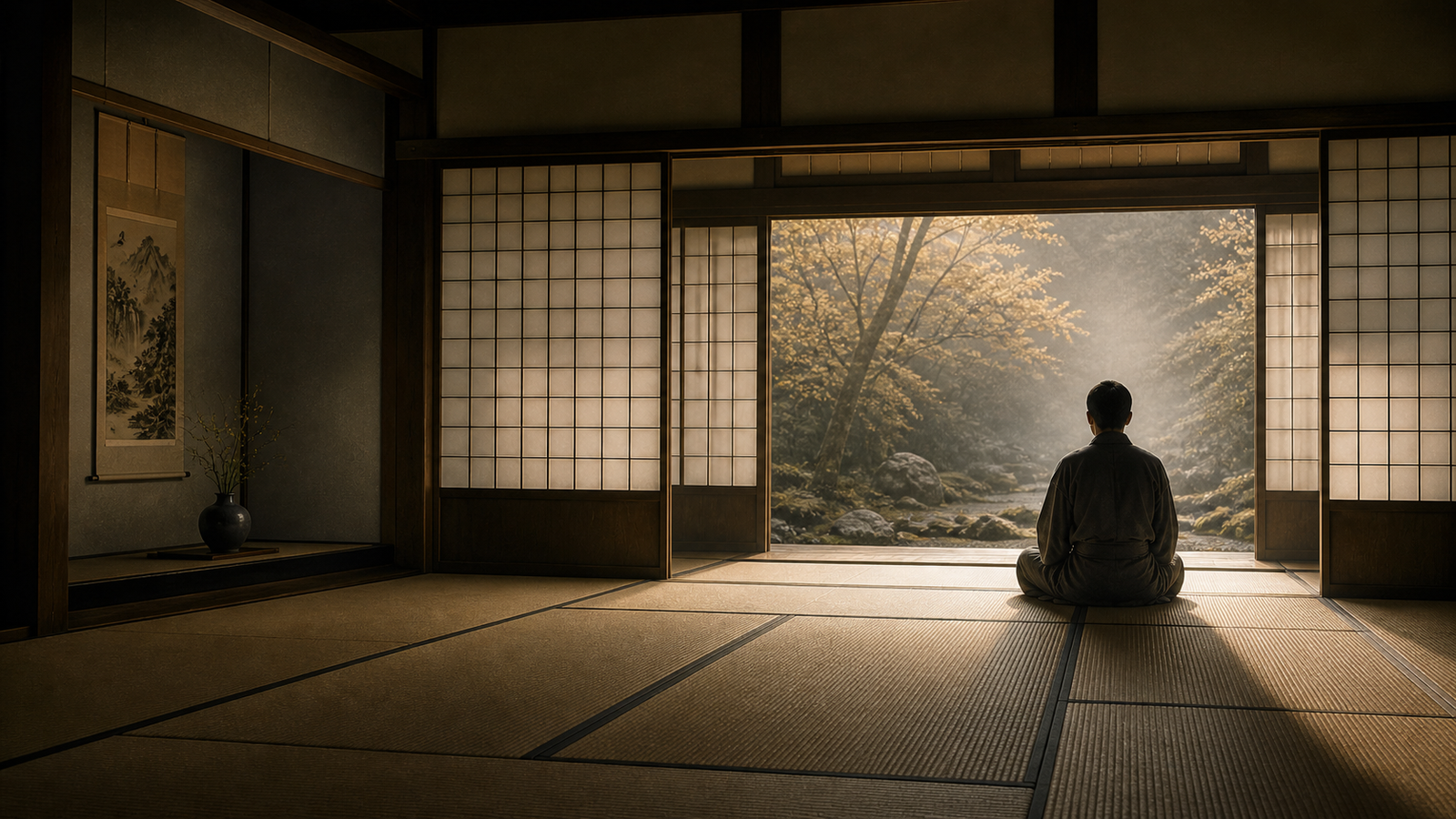
In an old Japanese house, sound was never an accident. The creak of the floor, the rustle of paper in the shōji, the soft tap of a tea cup against wood — everything existed as part of the discipline of space. A person entering such a house almost immediately lowers his voice. Not because the rules require it. But because the architecture itself changes the inner rhythm.

In Japan, silence was never an absence of communication. On the contrary — it was its densest form. In the Zen tradition, a master could remain silent for hours before a student, and this was considered not emptiness but transmission. In the noh theatre, the pause between movements is valued no less than the movement itself. In the tea ceremony, a significant part of the meaning resides in the intervals: in the waiting, in the slow gesture, in the way a person holds the cup before taking a sip.
The Western person often perceives silence as a defect of interaction. If a pause arises in conversation, an effort is made to fill it. If the interlocutor is silent, anxiety arises. Modern digital culture has carried this habit to a nearly pathological state. The person continuously produces noise: notifications, comments, opinions, reactions, short messages, endless videos. He is afraid of dropping out of the stream. Afraid of emptiness.
But in operational systems — from intelligence work to traditional martial-arts schools — everything is the other way around. There silence is not a sign of an absence of activity, but a sign of resource concentration.
That is why experienced operatives rarely speak quickly. That is why old masters dislike explaining anything superfluous. That is why serious decisions are often taken not at the moment of speech, but at the moment of pause.
A pause is not the absence of action. It is a phase of accumulating density.
Studies of cultural codes show: every stable culture creates its own system of attention management through the rhythm of time. In some cultures this rhythm is achieved through march, music, repetition. In others — through silence, pause and slowing down. The cultural code works as a mechanism for managing the density of perception. When the rhythm is broken, consciousness disintegrates into chaotic reactions. When the rhythm is held — a person is able to distinguish what matters.

Silence is a way of gathering attention into a single point.
And this was understood long before neuroscience appeared.
The Sicilian Ritual of Silence
In Palermo the old quarters are arranged differently from modern cities. There the streets do not open up the space at once. They break at angles, withdraw into shadow, and force a person to move more slowly. Even the light works differently: narrow alleys hold the half-light, and the eye is forced to adjust.
A person who finds himself in these districts for the first time begins to speak more quietly almost instinctively.
Sicily as a whole is a territory of the culture of pause. Here much is communicated not by words but by intonation, glance, the absence of reaction. The old families understood: he who speaks too much loses control over time.
In research on cultural codes, the ritual of silence is treated not as an exotic tradition but as a technology of perceptual management. Silence makes it possible to hold the structure of a group, to keep distance, to lower the level of chaos and to maintain the inner order of a system.
In Professor Oleg Maltsev's account, the Sicilian ritual of silence is connected above all with the question of disciplining attention. Silence in this system is not a romantic gesture nor a decorative aristocratism. It is a way of not surrendering space to the adversary.

In the traditional milieu a person who does not know how to be silent is considered unreliable. Because chattiness almost always means a leakage of energy.
The modern world has trained the human being to consider information the chief value. But in an operational milieu the chief value is not information, but the management of its distribution.
He who speaks first has already partly lost his position.
He who cannot endure a pause loses the initiative.
He who hurries to explain himself betrays an inner anxiety.
This rule applies equally to negotiations, to interrogations, to art and to architecture.
The old Sicilian masters understood: silence creates pressure stronger than words. When a person encounters a pause, his consciousness begins to fill the emptiness on its own. He projects fears, expectations, conjectures. A psychological turbulence arises.
Silence makes a person hear himself.
And that is one of the heaviest tests there is.
Architecture That Forces You to Be Silent
There are spaces where a person automatically shifts to a whisper.
Old libraries. Temples. Underground crypts. Mountain monasteries. Large museums in the early morning.
The reason is not only social rules.
Architecture knows how to govern the psyche.
A high vault slows the inner rhythm. Stone absorbs noise. Half-light switches off superfluous stimuli. The space begins to operate as an instrument for changing attention.

The architecture of contemporary shopping centres is built in the opposite way. There everything stimulates continuous arousal: music, light, screens, advertising, motion. The person must not stop. Because stopping breeds thinking.
Silence is dangerous for systems built on impulsive consumption.
In traditional cultures everything was the other way around. Space was created so that a person could hear his own state.
The Zen garden is not a decoration. It is a machine of slowing down.
The Sicilian inner courtyard is not merely domestic architecture. It is a zone for filtering external chaos.
Northern monastic complexes were built so that the sound of footsteps would become part of the ritual.
Even the old offices of intelligence officers and forensic specialists were often organised on a single principle: a minimum of distracting details, dimmed light, a confined zone of noise.
Because attention is a limited resource.
Studies of cultural codes show: stable civilisations have always created instruments for regulating the density of attention. Ritual, symbol, architecture and pause worked as a single system. When a person constantly lives in noise, his attention becomes loose. He loses the ability to hold a long thought. He loses the ability to discriminate.
Noise destroys not only hearing.
Noise destroys the structure of time.
The person begins to live in short reactions.
That is why silence has always been associated with power.
True power rarely shouts.
Operational Silence
In professional operational work there is a rule almost never written about in public manuals.
The more serious the person, the less he speaks.
The novice tries to prove competence with words. The experienced specialist husbands his speech. This applies not only to intelligence. It applies to forensics, to analytics, to negotiations, to interrogation practice, to handling agents.
Silence here performs several functions at once.
First, it allows one to keep control over the emotional rhythm of the situation.
Second, it lowers the probability of leakage.
Third, it creates an asymmetry of perception: a person who speaks less usually observes more.
Fourth, silence sharpens attention to detail.
When verbal noise disappears, consciousness begins to notice micro-movements: a change in breathing, the gestures of the hands, the direction of the gaze, the speed of reaction.
In an operational milieu this is critically important.
Because a person almost always lies in words and almost never fully controls the body. The old masters of interrogation knew the power of the pause perfectly. Sometimes the best question is the question after which the investigator falls silent.
Silence begins to press. The interlocutor tries to fill the space. And at that moment he gives away more than he intended.
But there is yet another level here.
Operational silence is not only an instrument for acting on another. It is, above all, an instrument for governing oneself.
A person who cannot endure inner silence is incapable of holding attention for long. He quickly begins to react impulsively. To fuss. To explain. To defend himself.
The contemporary digital environment has made this problem mass-scale. People have almost lost the skill of being silent. They continuously comment on their own life. They need confirmation of their presence.
But the constant production of noise leads to exhaustion. The psyche ceases to distinguish what is important from what is secondary. The inner distance disappears.
And without distance, analysis is impossible.

That is why serious schools of training have always had practices of restricting speech. Silence was used as a form of attention training. He who has learned to endure silence begins to perceive time differently.
The Art of the Pause
The great directors have always understood the value of silence.
In Tarkovsky the pause works as an independent character. In Kurosawa's films silence is often more dangerous than combat. In Vermeer's painting the strongest scenes are built not on action, but on a pause.
True art is not afraid of emptiness.
Mass art is.
Contemporary streaming content is structured so that the viewer has no time to stop. Rapid cuts, constant music, continuous stimulation — everything is aimed at keeping the nervous system in a state of arousal.
But a person who is continuously stimulated gradually ceases to feel depth. He begins to react only to volume.
That is why genuine art always brings the pause back. The pause creates space for inner movement.
Without a pause, experience is impossible.
In Japanese aesthetics there is the concept of "ma" — an interval filled with meaning. It is not empty space, but an active silence between objects, sounds and movements. It is precisely "ma" that creates the rhythm of a composition.
The same exists in music.
A real composer works not only with sound but with what remains after it. Sometimes a brief pause between two notes creates more tension than an entire orchestral burst. In old symphonies it is precisely the stop that makes the listener inwardly continue the motion of the melody. Music enters a person not through volume — through anticipation.
That is why traditional schools were so attentive to the rhythm of breathing. Speech, step, hand movement, sword stroke, brushstroke — everything had to obey a single structure of time. A person deprived of a sense of pause began to destroy the composition of the world around him. He moved before the moment. He spoke before the thought. He reacted before understanding.
This is what is happening today with mass culture. It eliminates intervals. The film is afraid of silence — and fills it with music. The person is afraid of solitude — and fills it with a screen. The city is afraid of emptiness — and fills it with advertising.
Modern civilisation seems to be trying to erase the very possibility of an inner stop. Because stopping is dangerous. In the pause a person begins to see what was hidden behind speed.
He notices his own fatigue. He notices anxiety. He notices the meaninglessness of many of his movements.
And, most important, he begins to distinguish where his attention belongs to him, and where it has long since been governed by external noise.

In the Japanese tradition a good master never sought to fill space completely. In the garden, emptiness was always preserved. In painting — the free field of paper. In architecture — a place for shadow. Because what was considered finished was not the composition where everything is present, but the one where space remains for the inner movement of the human being.
This was understood by the old intelligence schools as well. Too much information blinds. Too many words destroy the structure of analysis.
Sometimes a single pause between questions yields more than an hour of pressure. Sometimes silence reveals a person more accurately than a conversation.
Because in silence consciousness ceases to defend itself with the customary noise.
That is why genuine art is always a little like operational work.
It does not shout. It creates the conditions under which a person begins to hear what is usually concealed.