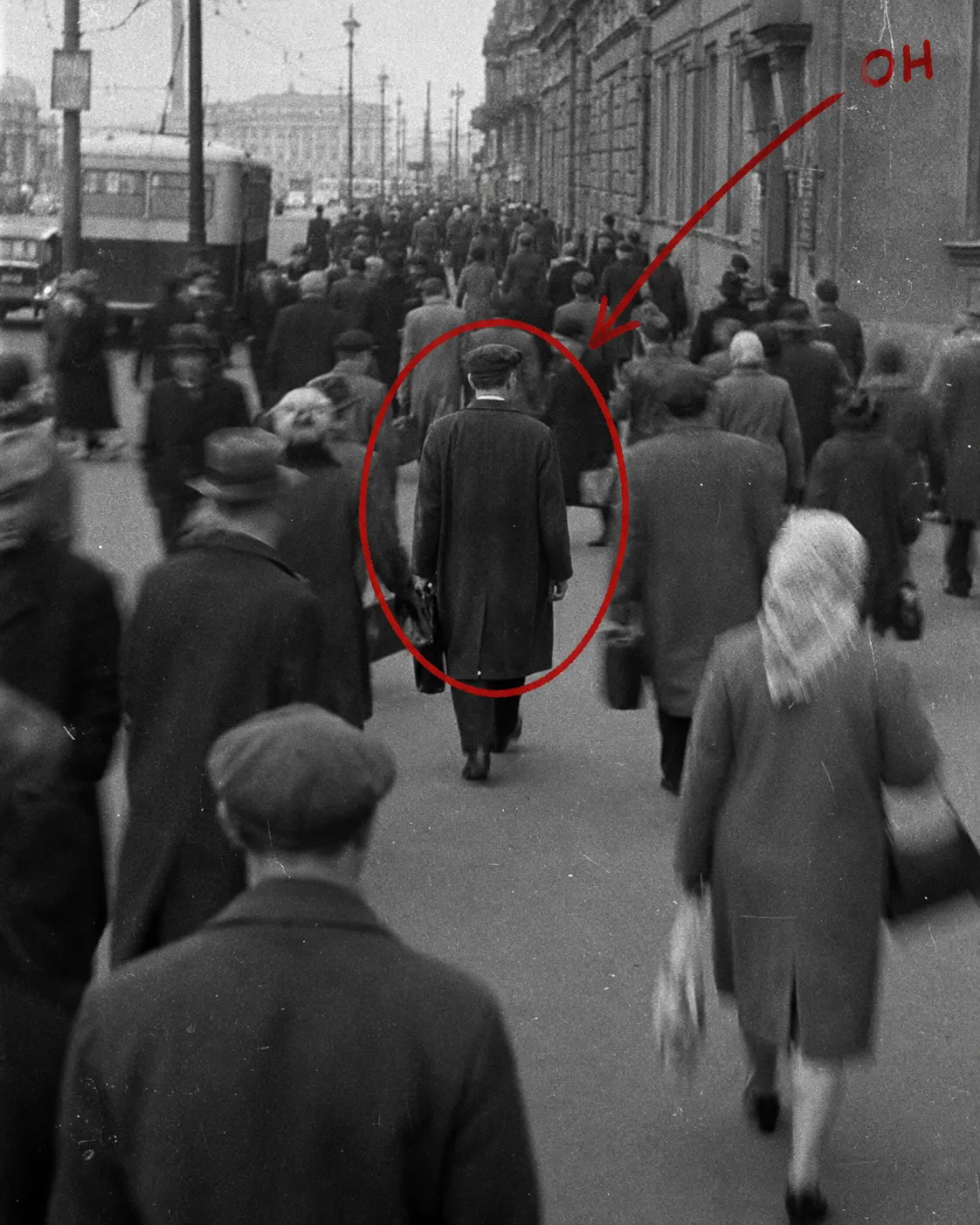
Invisibility is not the absence of presence. It is presence indistinguishable from the background. The most ancient and the most contemporary of applied sciences.
The city does not forgive a single excess movement.
Not the one who runs — everyone notices him. Not the one who hides — he is searched for on purpose. The city punishes the one whose movementdoes not match the rhythm of the environment. The person who walks slightly faster than necessary. Who turns his head a fraction of a second later than the situation demands. Who places his foot differently from the way a tired passer-by places it at the end of a working day.
It is precisely this mismatch that those who know how to look actually see.
The science of covert movement has existed for as long as the necessity of moving unnoticed has existed. It was developed in the mountains of Iga Province in medieval Japan. It was rediscovered in the trenches of the First World War. It was rewritten in the protocols of twentieth-century urban reconnaissance. Today it is once again relevant — only the background is no longer the forest or the battlefield, but the megalopolis with its cameras, its recognition algorithms and the density of its human flows.
The substance has not changed once.
I. The Paradox of the Invisible Man
The first and chief misconception about covert movement is the notion that invisibility is achieved by reduction. Less sound. Less movement. Less presence.
This is incorrect.
Genuine invisibility is achieved throughcorrespondence. A body that moves in the precise rhythm of the environment is not registered by an observer — neither human nor algorithmic — not because it is absent, but because itcreates no anomaly. It is part of the pattern, not a deviation from it.

This is a fundamental shift of logic. The task is not to disappear, but tomerge. Not to stop, but tocoincide with the flow. Not to fall silent, but tospeak the language of the environment.
It is precisely this understanding that lies at the foundation of all historical systems of covert movement — from the Japanese mountain schools to the Soviet reconnaissance manuals. And it is precisely this understanding that today is becoming central in the theory of urban navigation.
II. Iga and Kōga: Movement as Dissolution
The Japanese provinces of Iga and Kōga gave the world what was later summarised under the general term "ninjutsu" — although the practitioners themselves never reduced their system to a single name. These were closed family schools, each with its own methodology, transmitted orally across generations.
The central principle of movement in these schools was a notion that can be translated approximately as"the movement of water" — the capacity of the body to take on the form of space without resisting it. Not to break through the medium, but to flow along its natural channels.
Biomechanically this was expressed in several specific principles.
Low centre of gravity. Hips dropped, knees slightly bent. This reduces the amplitude of the body's vertical oscillation while walking — the characteristic rhythmic sway by which a person can be identified at a distance even in the dark, even in a crowd.

A roll from the outer edge of the foot. An ordinary step begins with a strike of the heel. The covert step begins with the outer arch of the foot, smoothly transferring weight onto the balls. This eliminates the impact pulse that propagates through hard surfaces and is heard far further than the walker imagines.
Control of breathing as a rhythmic signal. The breathing of a person under tension or fear creates a noticeable acoustic and visual pattern. The chest moves differently. The exhalation is audible. Steam from the mouth on a cold day gives away a position more accurately than any sound of footsteps.
These principles were not mysticism. They wereapplied physiology worked out by generations of people whose lives depended on the precision of their observations.
III. The European Tradition: A Shadow in a Different Forest
In parallel, without any contact whatsoever with the Japanese schools, European military practice was producing similar solutions.
Medieval reconnaissance manuals — in particular, German and Italian manuscripts of the fourteenth–fifteenth centuries devoted to the actions of scouts — describe the technique of the "soft step" in practically the same words as the Japanese sources. Weight transferred through the outer arch. Knees bent. Movement along the shadow side of objects, not across open space.
This is no accidental coincidence. It isconvergent evolution — the independent emergence of identical solutions in response to identical tasks. The human body is built the same way in every culture. The physics of hard surfaces does not change with geography. And so those who took the task of covert movement seriously arrived at similar answers — regardless of the forest in which they were working.
By the eighteenth–nineteenth centuries European military science began to systematise this knowledge. The first written manuals appeared for jäger riflemen acting in extended order. Then for reconnaissance detachments. Then for sabotage groups.
The general logic remained unchanged:invisibility is achieved not by speed and not by force, but by a precise correspondence between the movement of the body and the expectations of the environment.
IV. The Soviet School: Science at War
The experience of the Second World War created in the USSR a powerful practical impulse for the systematisation of covert-movement techniques. Reconnaissance and sabotage operations in urban environments — especially under the conditions of occupied cities with their dense building, curfews and control systems — set fundamentally new tasks before trained soldiers.
The forest allows you to take cover. The city does not. The citywatches.
In the city there are no shadows deep enough to hide in for long. But the city has something more valuable:rhythm. The city lives by a schedule. Patrol shifts. Market opening hours. The movement of trams. The behaviour of the civilian population at different hours of the day.
Soviet manuals on reconnaissance training of the period — in the part that concerned movement in inhabited localities — formulated the key principle thus:the soldier must move like a local resident, and not like a person who is trying not to be noticed. The difference between these two states is enormous, and is read by an observer instantly.
A local resident knows where he is going. His movement is purposeful but relaxed. He does not look around more often than necessary. He knows which pavement is broken and where to go around it. He does not slow down before checkpoints — because slowing down is itself a signal.
This was a fundamental transition fromthe technique of the body tothe technique of behaviour. From the question "how do I walk?" to the question "who am I at the moment of moving?"
V. The Biomechanics of Invisibility: What Happens in the Body
Modern science makes it possible to explain what historical systems described intuitively.
The human visual system — and especially its peripheral part — is tuned not to fix objects, but to fixchanges. That is why a motionless person in open space can remain unnoticed considerably longer than one who moves. And that is whythe character of the movement matters more than the movement itself.
The three parameters by which an observer — consciously or peripherally — identifies a "wrong" movement:
Vertical oscillation. Ordinary walking creates a vertical oscillation of the body with an amplitude of about 4–6 centimetres. A person in a state of heightened attention or fear involuntarily tenses his muscles, whichincreases this amplitude — making the movement more noticeable, not less. All historical systems independently solved this problem by lowering the centre of gravity and bending the knees.
Rhythmic predictability. Normal walking is metric — equal intervals, equal steps. This creates an acoustic and visual pattern that stands out easily against the environment. Covert movement deliberatelybreaks the metricity — varying the length of the step, the pace, the pauses — making the motion arrhythmic and harder to predict for an observer.
Direction of the gaze. A person who is searching for a threat or controlling space displays a specific pattern of eye movement: frequent horizontal scanning movements with brief fixations. This is read by the observer's peripheral vision even at considerable distances. A trained operator usesperipheral vision for observation, keeping the focus of his gaze neutral — directed at a point that draws no interest.
All three parameters can be trained. All three were described — in different words, but with equal precision — in the historical systems of covert movement.

VI. The City as the New Forest
The contemporary megalopolis has created conditions for which the historical systems were not designed — but the principles of which work in it with surprising precision.
The city watches differently from the forest. In the forest, the eyes of the patrol watch. In the city, cameras, algorithms, and — most important of all —other people watch, every one of whom is a passive sensor of the environment.
This changes the task of covert movement fundamentally.
In the forest one must be quiet. In the city one must beordinary.

The urban crowd works as a filter: it automatically screens out behaviour that does not match the context. A person in a business suit at the market. A person with empty hands by a shop. A person standing on the pavement without visible reason longer than waiting for a bus requires. Every such mismatch activates the "social radar" of those around — not consciously, but inevitably.
The protocols of urban navigation, developed on the basis of a synthesis of historical systems and contemporary urbanism, are built around the notion of"behavioural camouflage" — the creation of full correspondence between one's own movement and the social context of the environment.
This includes several levels:
Tempo. The speed of movement must match the speed of the flow characteristic of this place and time of day. The morning business district — fast and purposeful. The evening market — slow and with stops. A residential district in the middle of the day — unhurried, with small route deviations.
Props. Hands occupied with an object appropriate to the context — phone, bag, coffee — immediately place the figure in a comprehensible social category. Empty hands hanging at the sides — an anomaly.
Route. A straight-line movement from point A to point B, without deviations, looks purposeful and professional. Movement with small natural deviations — a shop window, a stop for a phone call, a change of side of the street — looks like ordinary everyday movement. The first is remembered. The second is not.

VII. Comparative Analysis: What Has Remained, What Has Changed
Comparing the Japanese schools of the fifteenth century, the European manuals of the eighteenth and the Soviet protocols of the twentieth, we can isolate an invariant core — what has not changed once in six centuries:
Invariant: the lowering of vertical oscillation, control of the acoustic trace of the step, management of the gaze, correspondence to the rhythm of the environment.
What has changed: the environment. The forest has been replaced by the city. The patrol has been replaced by the camera. The observer's hearing has been replaced by an algorithm of pattern recognition.
This means that the historical systems are not obsolete. They requiretransposition, not replacement. The biomechanical principles developed for movement along the temple corridors of Iga work in the Moscow metro under the same physiological laws. The principle of "the movement of water" — dissolution into the environment — works in Berlin Airport just as it worked on the forest paths of Kōga Province.
The task of the modern specialist is not to study history as a museum exhibit, but toread it as a working technical document.
VIII. Afterword. The Step That Was Not There
There is a special quality of mastery in any of these arts that does not yield to instrumental measurement and is not registered by cinegrams.
It is the moment when movement ceases to be a conscious effort and becomes astate. When a person does not think about how he places his foot — because the body already knows. When he does not calculate his correspondence to the environment — because heis the environment.
All historical systems describe this moment as the summit of training. Japanese sources called it merging with space. Soviet manuals — "natural behaviour in unnatural conditions". Modern neuroscience would call it theautomatisation of a complex motor skill — the transfer of control from the cortex into subcortical structures.
The words are different. The phenomenon is one.
And the path to it runs through the same thousands of repetitions under conditions close to the real. Through the same slow, dull, methodical labour described by Spiridonov in his notebook. Which Bulochko measured on the fencing strip. Which Gareev called "the resilience of the system under conditions of chaos".
The step of the shadow is not a trick. It is the result of work the traces of which are not visible.
That is why it is called the step of the shadow.
"The most dangerous movement is the one no one noticed. The hardest movement is the one that looks like an ordinary walk." — from working materials of a tactical-navigation course

Prepared on the basis of a comparative analysis of the historical systems of tactical movement and contemporary urban-navigation protocols.

