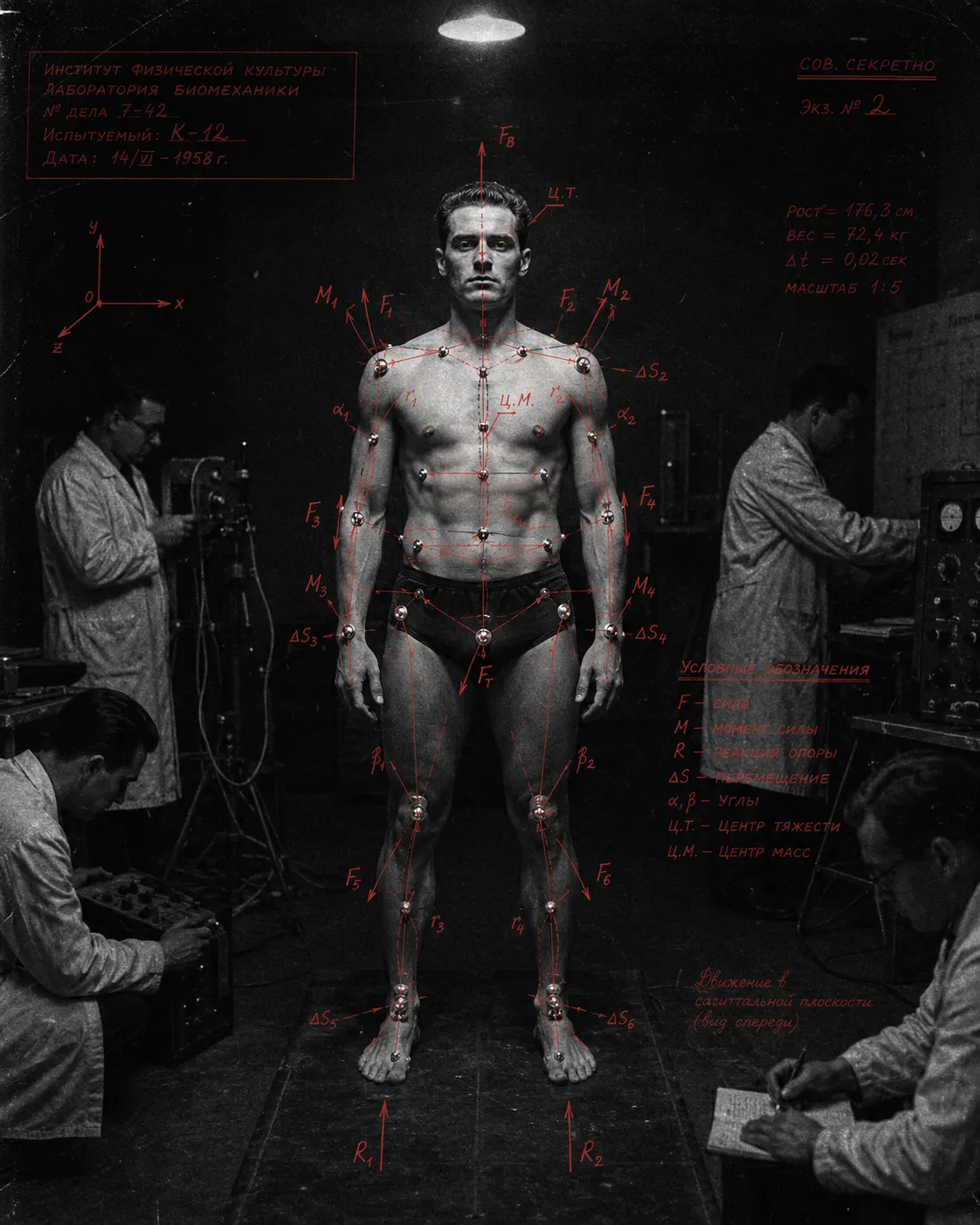
They were not artists. They were engineers of the human body. And what they recorded on yellowed millimetre tapes has not yet been read all the way through.
In February 1944, when the front line already knew which way victory was leaning, but its price had not yet been fully paid, a man in military uniform inside the structures of "Dinamo" was finishing the last pages of his work. His name was Viktor Afanasyevich Spiridonov. Outside the window it was February. The ink in his fountain pen cooled more slowly than the belief that the work would be finished. Spiridonov knew: he would not have time. Lung cancer — a verdict without appeal. But the records — would remain.
The records remained.
The question is whether we are able to read them today.
I. The Body as a State Task
Soviet science did not study the body out of curiosity. It studied the body out of necessity. After the First World War, after the Civil War, on the eve of the Second — the state knew: war does not end. Only its form changes. Which means that the body of a soldier is a strategic resource that must be studied, normalised and reproducible.
This was a fundamental departure from the European approach. The German fencing schools of the nineteenth century treated the body as an object of aesthetics and the duelling code. The Japanese systems treated it as an object of spiritual discipline. Soviet science approached the body the way one approaches a steam-locomotive boiler: what is inside, what is the efficiency, where is energy lost, and how can this be eliminated.
It was a cold and brilliant point of view.
And it was from this point of view that what we might today callapplied biomechanics of combat grew — a discipline that had no official name, but had people, protocols and results.
II. Spiridonov: the First Cartographer of the Body
Viktor Afanasyevich Spiridonov came to science through pain. A concussion in the First World War put an end to his line service. This circumstance, which could have been a verdict for a military man, became his methodological key: how does one preserve the combat readiness of a system when it is not working at full capacity? How does one transmit what the body knows to those who are only beginning to learn?

The answer he was seeking led him to the structures of "Dinamo" — the sports society set up under the organs of state security. Here, in closed gyms, Spiridonov began to systematise what before him had existed as scattered practice: jiu-jitsu grips, freestyle-wrestling throws, French-boxing strikes. He himself could no longer demonstrate the techniques — he observed, recorded, analysed. This forced distancing from the body paradoxically made his gaze more precise.
In his works — "A Manual of Self-Defence Without Weapons According to the Jiu-Jitsu System" of 1927 and the expanded edition "Self-Defence Without Weapons" of 1933 — he formulated, for the first time in Russian-language literature, what we would today call the concept ofthe motor reflex under stress. Spiridonov recorded an observation that in his time looked applied, but proved fundamental: at the moment of real threat, the body does not perform the technique. It performsthe trace left by the technique — an imprint left by thousands of repetitions in conditions close to combat.
The distinction is fundamental. This is not the execution of a movement. It isthe reproduction of a pattern. And if the pattern is recorded incorrectly, no act of will can correct it at the moment of danger.
Spiridonov, in essence, discovered what neuroscience would call "procedural memory" only decades later.
III. The Laboratory: How They Measured the Invisible
The task of measuring movement in combat looks technically simple only at first glance. In reality it was one of the most difficult engineering problems of its time.
A film camera gave only the external picture. Strain gauges — only the force. A chronometer — only the time. None of these instruments alone could answer the central question:at what moment does the body pass from a state of waiting into a state of action, and what happens in that interval?
It was precisely this interval — what is today called "reaction time" or "the pre-start state" — that became the principal object of research in the post-war laboratories.

The method of cyclography, used by N. A. Bernstein as early as the 1920s and developed in the following decades, made it possible to record photographically the trajectory of limb movement using attached light markers. The result was long exposures on which movement turned into glowing arcs — mathematically precise, irrefutable. This was the first "motion capture" of Soviet science.
Cinegrams — frame-by-frame analyses of film stock — made it possible to measure the angular velocities of joints and the times of movement phases to an accuracy of 1/50 of a second. Thousands of such strips have been preserved in the archives, on which wrestlers, boxers and fencers are frozen in the phases of a strike, a grip, an evasion — like insects in amber.
Strain-gauge platforms beneath the wrestling mat measured the distribution of foot pressure at the moment of a throw. The results were unexpected: the centre of gravity of an experienced wrestler at the moment of a throw shifted not where classical theory had indicated. The body knew something science did not.
IV. Bulochko: Fencing as the Pure Mathematics of Time
If Spiridonov dealt with the body in hand-to-hand combat, then Konstantin Trofimovich Bulochko made the object of his investigation something even more elusive —time.
Fencing, unlike wrestling, is built not on strength and not on technique as such. It is built ontempo — a notion that in the Russian fencing tradition has an entirely concrete, almost mathematical meaning: the minimum interval of time required to perform a single purposeful movement.
Bulochko travelled the road from athlete — multiple champion of the USSR in foil and sabre — to a major methodologist, head of the fencing department at the Lesgaft Institute of Physical Culture, founder of the Leningrad school. A veteran of the Great Patriotic War, in parallel he developed the methodology for training soldiers in hand-to-hand combat techniques and systematised the scientific foundations of fencing.
His observations, fixed in methodological manuals of the 1950s–60s, formulated an idea that today can be read in the language of neuroscience:the fencer's brain does not react to the movement of the opponent's blade. It reacts to the intention preceding the movement.

This idea — reaction to intention rather than to action — was revolutionary. It meant that an experienced fighter reads the opponent's body as a text in which every micro-movement of the muscles, every barely perceptible shift of weight, is a letter in a word being spoken before the strike.
Bulochko systematised these "warning signals", developed a methodology for training their recognition, and, in essence, created the first Russian-language programme for the training oftactical vision. His writings, including the foundational textbook "Fencing" (1967) prepared under his editorship, contain propositions that combat-training methodologists still cite today.
One of the key ones:victory belongs not to the one who moves faster, but to the one who knows earlier where to move.
V. Gareev and the Doctrine of Live Action
Military science approached the problem of the body from a different angle — not through the gym, but through the battlefield and the operational headquarters.
General of the Army Makhmut Akhmetovich Gareev, who began the war as a young officer in 1941 and rose to become deputy chief of the General Staff of the USSR, in his scientific writings of the 1970s–80s repeatedly addressed a problem he labelled "the human factor in modern combat". Behind this academic term lay a concrete and harsh reality: under conditions of real combat contact, the human being ceases to be the executor of doctrine. He becomesa biological system in emergency mode.
Gareev pointed to a fundamental contradiction in military training: regulations describe the soldier's actions in idealised conditions, but combat never unfolds in idealised conditions. This means that the real object of training should be not the technique, butthe resilience of the system — the capacity of body and mind to function adequately under conditions of total informational and physical chaos.

This observation, formulated in the language of military doctrine, echoes what Spiridonov had found in hand-to-hand combat and Bulochko had found in fencing. Three men, working in different disciplines and at different times, independently of one another were describing the same phenomenon.
They were describingthe body as a navigational system that takes decisions faster than consciousness can register them.
VI. What Was Lost — and Why
Soviet movement science did not perish from a lack of results. It perished from interdepartmental barriers.
The research conducted by the structures of "Dinamo" (Spiridonov), the sports institutes and physical-education departments of the military academies (Bulochko), the General Staff and the military-scientific administrations (Gareev) existed in parallel universes. Data exchange between them was minimal, and often impossible for reasons of secrecy.
As a result, each of these directions reached a certain ceiling within its own field — and stopped. No synthesis took place.

Moreover, a significant part of the primary data — cinegrams, strain-gauge readings, laboratory test protocols — was classified as "materials of applied significance" and ended up in archives access to which is to this day either restricted or technically obstructed. A portion of the films has degraded physically. A portion of the documents perished during the relocations of institutes in the 1990s.
What was lost was not the technique. What was lost wasthe methodology of observation.
VII. Reconstruction: How to Read the Archive Today
Modern science has at its disposal instruments Spiridonov could only have dreamed of. Motion-capture systems with millimetre precision. Real-time neuroimaging. Electromyography down to individual muscle fibres.
But an instrument without a question is merely a machine.
What the works of Spiridonov, Bulochko and the theoretical legacy of Gareev give us above all arethe right questions. Not "how fast does the hand move?", but "at what moment does the body decide to move?". Not "what is the trajectory of the strike?", but "what signal triggers it?". Not "how do you defeat the adversary?", but "how do you preserve the function of the system under extreme load?"
It is precisely these questions that today underpin the training programmes of operators in special structures — from anti-terrorist units to analysts working under information pressure. A body that "knows" where to move before consciousness has formulated the task is not mysticism. It is a measurable, reproducible and, most important,trainable result.
The archives of the laboratories of the past are not a museum. They are an unfinished technical assignment.
VIII. Afterword. September, 1944
Spiridonov died on 7 September 1944, never seeing the victory he had brought closer by training the soldiers of OMSBON in hand-to-hand combat during the hardest years of the war.
He did not see how his system would be reconceived and built into new state programmes. He did not learn that a decade later Konstantin Bulochko would be sitting and measuring the reaction time of fencers with a precision he could not have imagined. He did not live to see Gareev formulate, in the language of an operational headquarters, what he himself had reached for in the closed gymnasium of "Dinamo": resilience matters more than technique.
But he left the most important thing:the conviction that the body is an archive. An archive that can be read, decoded and rewritten.
In an age in which the urban environment, digital noise and informational pressure create a load comparable to that of combat, this archive becomes not an academic rarity, but an applied instrument.
One only needs to know how to open it.

"The body knows the path before the mind formulates the route. The task of training is to shorten the distance between these two moments." — from the working notes of training methodologists, 1950s.

