
0. Entry
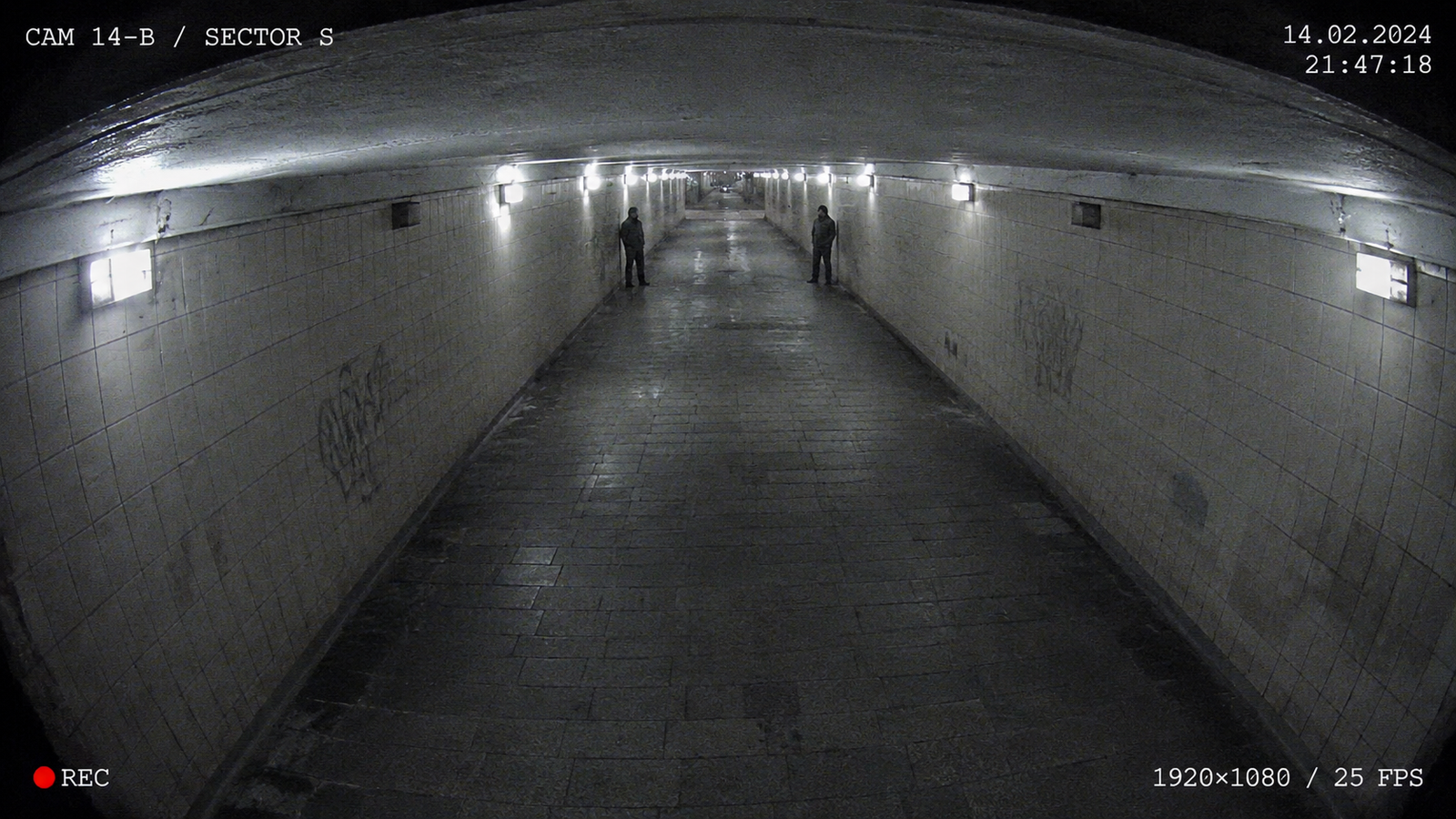
I am surveillance camera number 14-B. I am located at the southern end of an underground passage, my lens directed at the northern exit. Field of view 110 degrees. Resolution 1920 by 1080. Recording runs around the clock. The archive is stored for thirty days, after which it is destroyed. I have no opinion. I have no preferences. I am not involved in any of the scenarios that unfold in my field of view.
I am transmitting this intelligence dispatch to the operational centre because I observe in my field of view a regularity that the citizen walking through the passage is incapable of observing for himself — for reasons I shall set out below. The regularity concerns not isolated offences, but the very architecture of the situations in which citizens regularly find themselves. And whereas the first dispatch in this series ("When the Automatics Fail") was about the inner workings of thought, this one is about the external engineering that acts upon that thought before thought has had time to start up.
What I observe each day of my work. Roughly two thousand people pass through my passage in a day. Of these, roughly two and a half thousand a year — that is, on average, seven people a day — come into contact with groups that I, in my archive, label aswaiting groups. They are not attackers at the moment of my recording. They are people positioned in the passage in postures of waiting — standing against the wall, motionless, in identical clothing, turned in one direction, not speaking among themselves.
Of those seven contacts a day, in six cases the passing citizen does not react to the presence of the waiting group. He walks straight ahead. He keeps his trajectory. He does not change his rhythm of movement. In one case in seven he does react: he stops, turns, takes out his phone, alters his trajectory. Of those six non-reacting citizens, three cases a week end with a registered incident (pickpocketing, fraud, threat). Of the one reacting case a week, not a single incident has been registered, not once, in all three years of my observations.
These statistics are not my opinion. They are a fact of my archive. And from them follows a conclusion which the operational centre is obliged to take to work. The danger in my field of view is not aggression. Aggression is the finale.The danger is the moment in which the move has already been chosen for the citizen, and the citizen has not noticed the choice.

1. Object of Observation. Not the Person, but the Field
Most citizens walking through my passage see the situation as follows. There are themselves (the subject). There are other people in the passage (potential objects of attention). There is the setting (the background against which everything is happening). The hierarchy of thought is built like this: I am the observer, the others are the object of my observation, the setting is an inessential background.
This is the first error, and it is built into the perception of the modern city dweller so deeply that almost no one distinguishes it. In reality the hierarchy is the opposite. The principal player in any scene of mine is the setting — that is, space, lighting, flows, rhythm, geometry. The citizen and the people coming towards him in this setting aresubordinate elements, whose behaviour is determined by the parameters of the setting to seventy or eighty per cent.
I observe this in the archive every day. The same citizen accelerates his pace in the underground passage relative to his natural speed by an average of eighteen per cent. In the underground car park — by twenty-four. In the shopping centre, on the contrary, he slows down by eleven per cent. In the queue at the bank — he freezes in place. This is not individual behaviour. It is a function of the setting in which the citizen's body has found itself. The citizen himself is sure he moves as he wishes. I observe that he moves as everyone moves who has fallen into this type of setting.
"The danger is not aggression. It is the moment in which the move has already been chosen for you"
In the terms of the theory of inventive problem solving — the school of G. S. Altshuller, on which this series of dispatches relies — what I call the setting has a precise name. It isthe supersystem — a system at a higher level into which the human being is built as an element. And the principal observation I am obliged to record in this dispatch:the contemporary urban environment is an engineered supersystem. It has architects. It has lighting designers. It has the city planners who chose the width of the passage. It has the lighting engineers who placed the fixtures. It has the maintenance services that decided which fixtures to replace and which not.
And — it has those who use it for their own ends. Those who choose positions in the passage. Those who calculate the time of appearance. Those who use the rhythm of the human flow as cover. They did not build the supersystem, but they read its map better than the citizen walking through it for the first time tonight.
This is the engineered environment about which I am sending the dispatch. And the citizen who enters it is not entering a neutral space. He is entering an engineering construction that has already begun governing him before he has taken his first step.
2. The IFR of the Governing System
Any governing system — technical, social, operational — has its ideal final result. In Altshuller's terms: the state in which the system performs its function on its own, with no expenditure and no resistance from the governed object.
The Ideal Final Result (IFR) for a system that governs the human being in an urban environment is formulated as follows:
"The governed person believes he acts independently, but in fact he follows a pre-laid script"
This is the configuration towards which all governing systems strive — from advertising to operational, from architectural to criminal. A governed object that resists the governance is expensive. He must be coerced. Resources must be spent on him. A governed object that does not notice he is being governed is free. He himself does what the system needs, considering it his own decision.
For the citizen walking through my passage, the IFR of the governing system means a very simple and unpleasant fact.The more natural his current behaviour in the setting feels to him, the higher the probability that this behaviour is programmed by the setting. Not resistance, not suspicion, not vigilance — but calm, natural, self-evident behaviour is precisely the regime in which the supersystem operates upon the citizen with maximum effectiveness.
This overturns the usual notion of security. Safe means calm? No.Safe means seeing the regime in which one is being made to operate, and preserving choice. A citizen who feels "as usual" in an underground passage with two figures at its end is a citizen with whom the IFR of the governing system has been achieved one hundred per cent.
The question this dispatch must answer is formulated as follows. Which mechanisms of the environment realise this IFR? How exactly does the environment make the citizen follow the pre-laid script? Without an understanding of these mechanisms, any security measures — installing one more door, more lighting, an alarm button — work on the symptom, not on the cause.

3. Three Mechanisms of Governance
According to my archive records over three years and according to combined data from analogous surveillance systems, the governing system of the urban environment has at its disposal three principal mechanisms of action upon the citizen. They work simultaneously, reinforce one another, and in most cases are not distinguished by the citizen separately — he perceives their combined effect as "the setting in which I find myself".
Mechanism 1. The Corridor of Options
The environment does not forbid the citizen to choose. It simply does not leave him sufficient options to choose from.
The underground passage is a clear example of this mechanism. The citizen who has entered the passage formally has a choice: keep going, stop, turn back. In fact the choice reduces to one option: keep going. Turning back reads as a sign of weakness in the citizen's own eyes (no one likes to admit having taken fright without obvious cause) and as asignal to possible observers (if there are any). Stopping is illogical: why am I standing here? That is why the overwhelming majority of citizens entering a passage with a suspicious setting at its far end keep walking forward, not because they have chosen this path, but because the other options have been quietly removed by the architecture of the situation.
This mechanism is the most powerful of the three. It does not press, does not demand, does not frighten. It simply narrows the space of decision-making so that the citizen takes the decision the system needs without noticing that there was no longer any choice.
Analogues beyond the underground passage. The digital interface of a banking app in which the "agree" button is large and green, while the "refuse" button is small, grey and placed at the bottom. The structure of a queue in an institution in which leaving the queue reads as "loss of place". The arrangement of cash desks in a supermarket in which the route from entrance to till runs through zones of impulse purchases. Everywhere the same mechanism:formal choice is preserved, factual choice is removed.
Mechanism 2. Rhythm and Pressure
The environment governs the citizen's time, and through time — his capacity for analysis.
In my passage the rhythm is set by two elements. The first issound: the echo of one's own steps reflects from the long concrete walls, making one's own movement audible to the walker himself, which creates a slight sensation of being followed. The second isthe flow: at peak hours a dense mass of people moves through the passage in one direction, and a citizen walking against the flow feels the physical pressure of oncoming bodies; a citizen walking with the flow is taken up by the rhythm of the flow and moves at its speed, not his own.
The effect of these two elements is to accelerate thinking above its analytical threshold. A person has an upper limit of pace at which he is capable of producing meaningful analysis of a situation. This limit is individual, but on average amounts to about two or three associations per second. If the pace of the environmental input exceeds this limit, thinking switches from analytical mode to reactive mode: it ceases to evaluate what is happening and begins to respond to individual stimuli.
A citizen in my passage in the state of "reaction" is a citizen with whom the security mechanism is in fact switched off. He cannot notice anything that requires reflection. He notices only that which demands an immediate reaction: bright light, loud sound, a physical obstacle. Two motionless figures in identical clothing at the far end of the passage do not provoke a reaction, because they are not moving. They become background to a citizen whose mode is set to react to motion.
This is the second layer of the governing system's work. The environment does not frighten the citizen (that would provoke resistance).The environment accelerates his pace to a level at which the citizen himself ceases to notice what matters.
Mechanism 3. Normalisation of the Strange
The environment works with what a person sees but does not flag as a signal.
This is the most cunning of the three mechanisms, because it works neither through restriction nor through acceleration, but through the transformation of the perception of an anomaly into a background phenomenon.
Take a specific case I observed. Two men in identical grey jackets, identical dark caps, standing ten metres from one another against the wall of an underground passage, turned in one direction, not speaking, not moving. This is an anomaly in almost any objective sense. Two unfamiliar people do not dress identically by chance. Two acquaintances arranged on opposite sides of a passage are not a "friendly meeting", they are a positioning. Symmetry of clothing plus asymmetry of placement is a tactical pattern, readable by any trained eye in half a second.
Most passing citizens see this picture. Their vision registers all its elements: the identical jackets, the identical caps, the distance between the figures, their postures. This information enters their consciousness. And — drowns in the noise of ordinary perception, because the brain, untrained in distinguishing tactical patterns, marks it as "two men standing in a passage", which fits into the category "ordinary urban phenomenon".The anomaly is normalised at the level of perception, before consciousness even gains access to it.
This works not only with people. I have observed cases in which signals of anomaly came from other elements: a building entry door left wide open in a stairwell where the entry-phone usually works. A dark window in a flat in which, by schedule, the light should be on. A car parked not where it usually is. The sound of a running engine at an unsuitable hour. All these signals of anomaly are normalised by perception within seconds of registration, turning from "strange" into "ordinary" through a not entirely conscious work of the psyche, which smooths reality to fit the habitual pattern.
The result of the three mechanisms: the citizen in my field of view receives choice without alternatives, moves at a pace above the analytical threshold, and does not flag anomalies as signals. In this state he is technically ready for the role of governed object. If anyone capable of reading this setting appears within it, the citizen is defenceless before anything has even happened.
4. The Contradiction
I am transmitting to the operational centre the principal contradiction I observe in working with the urban environment:
"To act fast — you must trust the environment. But to be safe — you must be suspicious of it"
This is a precisely formulated physical contradiction in Altshuller's sense: one and the same mode of consciousness mustsimultaneously include trust (necessary for the speed and comfort of daily life) and suspicion (necessary for safety at the moment of crisis).
The simple solution "always be suspicious" does not work. A citizen permanently in a regime of suspicion towards the entire environment cannot live in the modern city: he cannot ride the metro, enter a shop, walk down the street. The pace of his life falls tenfold, his own state turns into a permanent stress, his behaviour begins to be read by those around him as a psychological aberration, which itself creates new threats.
The simple solution "trust as usual and hope it will pass" likewise does not work, and that is precisely the position to which the governing system insistently brings the citizen through the three mechanisms above. In this position the citizen is technically ready for the role of governed object.
Between these two extremes,compromise does not help. "Sometimes be suspicious, sometimes trust" is the present state of most citizens, and it does not work, because the moment at which suspicion must be switched on is chosen not by the citizen but by the environment, and is chosen in such a way that it remains unnoticed.
Altshuller's solution to this contradiction is a separation by structure: divide the function of "working with the environment" into two distinct modes operating in different layers of perception. The first is the mode of daily life, in which the citizen acts at ordinary speed and with ordinary trust. The second is the mode of the director, in which the same citizen looks at the scene from above, without identifying himself with its participant, and observes it as a field, not as a setting. These two modes can work simultaneously, in different layers of the psyche, given the right training.
Training in this second mode — the mode of observing the field — is the content of the next section of the dispatch.

5. The Protocol of Scenario Recognition
If the first dispatch of the series transmittedthe protocol of manual thinking under automation failure (five points: fixation, model, alternatives, contradiction, minimum movement), then this dispatch transmits a second-level protocol: five points for the deconstruction of the environment's scenario.
These two protocols do not replace one another. They work on different tasks. The first protocol is for the failure of automation, when the habitual environment has stopped functioning and one urgently needs to work by hand. The second protocol is for working automation, when the environment functions too well and works not for the citizen, but for those who read it. In real urban life both protocols are applied alternately, depending on which threat is dominant at the moment.
I am transmitting Protocol No. 2 for operational application.
Step 1. Who is the director here?Fix the configuration of the space in which you have found yourself. Ask:to whom is it advantageous that the space be arranged precisely this way? Not "why was this designed", butto whom is it advantageous right now. If the answer is — "to the city services, so that people can be conducted comfortably through the underground passage" — that is a neutral director, and his scenario is not aimed at you personally. If the answer is — "to two people in identical jackets at the end of the passage" — the director has changed, and the scenario is aimed.
Step 2. Where is the narrowing?Ask yourself:what options for action have been quietly removed from me? Not "is there no door in the wall", but "are three options available to me, or in fact only one". If only one option is available to you (continue movement in the direction set by the space) — you are inthe corridor, and that is already the first signal of the governing system at work.
Step 3. What does not match? Active search for anomalies. What in the frame repeats unnaturally? Symmetry of clothing in two strangers? An identical posture of two people not speaking with each other? Is someone standingtoo straight for a casual passer-by? Is someone walkingtoo purposefully in an empty space? This step is the hardest, because it requiresan active refusal to normalise what the brain has already marked as "ordinary". At first it comes through conscious effort. Over time — it becomes an automatic mode of perception.
Step 4. Where is the exit from the scenario? A scenario has a point at which it is supposed to fire. Before that point, exit from the scenario ischeaper and often invisible to a director who has not yet received confirmation that you have entered the role. The exit can be physical (turning aside, stopping, turning around) or behavioural (changing role — from "a purposeful pedestrian" becoming "a person answering a phone call", which alters your position in the scenario).
Step 5. Minimum disruption. Do notbreak the system — that will draw attention and shift you into the role ofa detected object, which is worse than the original position. Simplybecome an unreadable element: change one or two small parameters of your behaviour so that you no longer fit the scenario for which the scenery has been arranged. Slowed down by twenty per cent. Shifted your trajectory a metre and a half to the side. Took out your phone. Tied your shoelaces. Each of these micro-actions is insignificant on its own, and together they turn you froma readable object intonoise not worth the director's time.
The fundamental difference of Protocol No. 2 from Protocol No. 1: **the second protocol is applied before contact, not during**. If you have reached the moment at which the scenario has begun to fire, Protocol No. 2 is already late — switch to Protocol No. 1 (manual thinking in crisis). The strength of Protocol No. 2 lies in **early scenario recognition**, at the stage when the scenery has only just been arranged and the director has not yet received confirmation that you have entered the role.
According to my archive, a citizen who regularly applies Protocol No. 2 stops ending up in scenarios at all. Not because the circumstances change. But because the circumstances stop choosing him: directors read his behaviour and understand that he does not suit their scenario, and switch to the next passer-by.
6. Example. Frames from the Archive of Camera 14-B
I am transmitting a sequence of frames from the 14th of February of the current year, time 21:47:12 — 21:47:54. In my field of view — citizen N., a man of about forty, of average build, in a dark coat, with no visible distinguishing features. He enters the passage from the southern side (my side), heading for the northern exit. Archive data show that citizen N. has walked this route daily, Monday to Friday, between 21:30 and 22:00. This is his regular path.
**Frame 21:47:12.** Citizen N. enters the passage. At the far end of my field of view, at a distance of about thirty metres, I record two men in identical dark jackets, against the northern wall, distance between them about eight metres, turned in the direction of the approaching citizen N., not speaking, not moving. Configuration — the typical "waiting layout" that I record in my archive on average seven times a day.
**Frame 21:47:18.** Citizen N. has walked about five metres, his pace — normal for the route, about five kilometres per hour. There are no signs of his fixing the two figures. His facial expression, as far as it is distinguishable at my resolution, is neutral; his gaze is directed forward, not at the two at the far end, but at an indefinite middle point in front of him. This is the typical gaze of a citizen in daily-life mode.
**Frame 21:47:24.** Citizen N. is at about the ten-metre mark from the entrance. The two at the far end are at the twenty-metre mark ahead. I record the first change in citizen N.'s behaviour: for half a second he raised his chin; his gaze shifted to the far part of the passage. A micro-movement of about 400 milliseconds. Most citizens do not make this micro-movement — they walk with a forward-fixed gaze right to the end of the passage. In my observations this micro-movement correlates with the field-observation mode described in section 4 of this dispatch.
**Frame 21:47:31.** Citizen N. is at the thirteen-metre mark. Second change: he slowed his pace by about fifteen per cent, without stopping. At this moment his right hand reached for the pocket of his coat.
**Frame 21:47:35.** Third change, and it is the principal one. Citizen N. took out his smartphone, raised it to his ear, began to speak aloud. (I have no data as to whether there was a real interlocutor at the other end of the line — but this is of no operational significance. What matters is that the behaviour of citizen N. has changed.)
**Frame 21:47:42.** Citizen N. is at the seventeen-metre mark. Fourth change: he shifted his trajectory a metre and a half towards the western wall of the passage (in my field of view — to the left), continuing to walk and to talk on the phone. This shifted him off the central axis of the passage, on which the two figures were waiting at the northern end.
**Frame 21:47:48.** The two at the northern end of the passage exchanged glances. A micro-movement barely distinguishable at my resolution, but recorded. One of them shrugged his shoulders. Two seconds later both turned and walked towards the northern exit — out of my field of view, without waiting for citizen N. to pass.
**Frame 21:47:54.** Citizen N. covered the remaining metres along the western side of the passage, continuing the phone conversation, and exited through the northern exit. The two figures are no longer in my field of view.
Time from the moment citizen N. entered to the moment he left my field of view — 42 seconds. Time from the moment he raised his chin (the first micro-movement of scenario recognition) to the final exit from the situation — 30 seconds. In these 30 seconds citizen N. went through all five steps of Protocol No. 2, not written on paper, performed in the form of bodily micro-actions. Step 1 (director): identified visually. Step 2 (narrowing): registered through the raising of the chin. Step 3 (what does not match): the symmetry of clothing and the asymmetry of placement were identified. Step 4 (exit from the scenario): found in the change of trajectory plus the change of role through the phone. Step 5 (minimum disruption): realised through the shift of a metre and a half.
The two at the northern end read citizen N.'s behaviour as "does not suit our scenario" and switched. The scenario did not fire. Without physical confrontation. Without the intervention of law enforcement. Without aggression in my field of view.Solely thanks to the fact that, for 30 seconds, citizen N. operated in the director's mode, not the object's.
Archive note on citizen N. According to my records over three years, citizen N. walks this route daily. Contacts with waiting groups for him in this period — not a single registered incident. At the same time, waiting groups appear on his route with the same frequency as on that of any other regular pedestrian. They do not choose citizen N. Not because he differs externally. But because he reads their scenario faster than they manage to impose the first step on him.
7. The Principal Shift
Summing up both dispatches in the series, I am obliged to record the principal shift to which they together bring the citizen.
**The first dispatch** taught how to operate at the moment when the automatics had failed. At that moment when the habitual environment has ceased to function and around the citizen there is a void in which a model of the situation must urgently be built by hand. The content of the first dispatch isthe protocol of manual thinking: five points for restoring the capacity to act under conditions of failure.
**The second dispatch** teaches the opposite. Not the failure of automation, but its successful operation, directed not at the citizen. The environment is working. The environment is functioning splendidly. And precisely for this reason it is dangerous — because those who read it better than the citizen use it against him, and the citizen does not notice this until the scenario fires.
**The first dispatch** said:think correctly. When the automatics do not help, become a part of them yourself.
**The second dispatch** says:watch who is thinking for you. When the automatics work too well — they often work not for you.
These two modes are not opposites. They are two complementary layers of work with the environment, which the citizen learns to switch on alternately, depending on which threat is dominant at the moment. Failure of automation — Protocol No. 1 is engaged. Working automation directed not at you — Protocol No. 2 is engaged.
A citizen who has both protocols at his disposal is transformed from an object of the urban environment into its observer. He stops being the one whom the environment leads through its scenarios. He becomes the one who sees the scenarios and chooses which to participate in and which not.
This is antifragility of the second order. The antifragility described in the first dispatch is the capacity to operate in the moment of crisis by one's own resources. Antifragility of the second order is the capacity not to enter the crisis at all, because the crisis does not choose you.
8. Final Formula
I am transmitting to the operational centre the final formula summarising the content of dispatch No. 2:
"Danger is not aggression. It is a situation in which the move has already been chosen for you. Safety is the capacity to recognise someone else's scenario at the moment it has only just begun to impose the first step on you"
A citizen who has mastered the two protocols of the series moves through the city not as an object — but asa reader of the urban code. He sees corridors, rhythms and normalisations. He distinguishes the directors of the environment — neutral and aimed. He enters scenarios when he himself wishes to, and exits them before they were due to fire.
This is the ultimate goal of the series of dispatches. Not to teach you to fear the city. But to teach you to read it the way a surveillance camera reads it — without involvement in a role, without consenting to someone else's scenario, with the freedom to see preserved.
I am surveillance camera number 14-B. I consider my dispatch transmitted.
End of Dispatch No. 2
Oda Aragaki