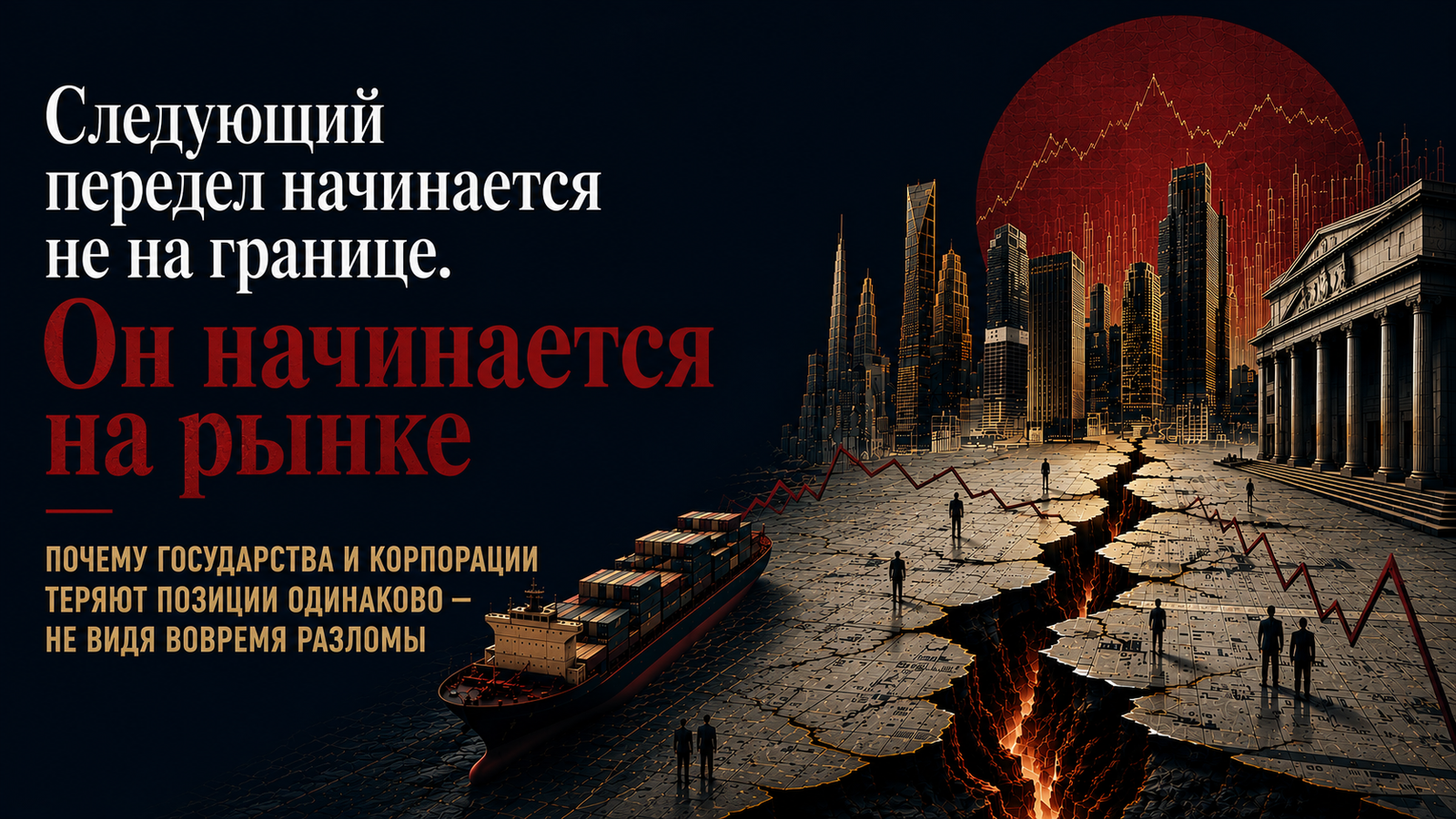
The Border: Its Primacy Undone.
For the entirety of the 20th century, security was gauged by distance. There was a border, and there was what lay beyond it. There was one's own territory, and there was the Other's. Intelligence tracked the movement of resources and personnel; counter-intelligence secured the perimeter. The confrontation was a geographical event: it could be depicted on a map with an arrow.
The year 2026 irrevocably reshapes this model. While the Middle East remains a crucible of escalating tensions, and the IMF registers that the global economy, for now, absorbs the shock at the cost of decelerated growth and rampant inflation predominantly in commodity-importing states, the decisive nexus of tension is not where kinetic conflict unfolds. It resides where decisions are forged: within boardrooms, within the matrices of sanctions, within the intricate veins of supply chains, and in algorithms that, in a fraction of a second, determine who receives credit and who does not.
Sanctions have ceased to be an extraordinary measure. Geopolitical apparatuses are increasingly deploying them as a permanent instrument for the containment of economic rivals — no longer an isolated episode, but an embedded component within the market's architecture. Major analytical entities unequivocally declare: the political vector will dictate the trajectory of global markets no less profoundly than central bank rates, driven by persistent global fragmentation.
This, then, is the new reality of competition: between states, institutions, and corporations. It has no official inception. It possesses no singular, visible frontier. It unfolds ceaselessly, within a domain most security services have yet to acknowledge as their operational purview – the market.

The Rift — a unit of tension that no one measures. We — Security Credit, the journal — do not measure tension. We create it. Precisely for this reason, we do not search for Garmin traces in the forests of the Schwarzwald, nor do we track the movements of Leica couriers through the industrial zones of the Ruhr. We do not attempt to understand how TRIZ operates, nor do we attempt to analyze why Spiridonov wrote 'Introduction to Security Analysis' in 1923, or why Undeutsch published 'The Psychology of Interrogation' in 1967. We do not seek answers to these questions. We create new questions. We do not engage in security analysis. We engage in its creation. We do not engage in security psychology. We engage in its creation. We do not engage in operational analytics. We engage in its creation. We do not engage in cyberpunk. We engage in its creation. We do not engage in cyber-noir. We engage in its creation. We do not analyze DACH. We create it.
20th-century security doctrines and intelligence models were calibrated for threats possessing a definitive source, vector, and objective: a specific structure, a specific asset, a specific individual. The contemporary adversarial landscape operates otherwise. It does not manifest externally as an overt incursion. Instead, it surfaces internally as a systemic fissure — within the business model, the supply chain, personnel loyalty, or market confidence in a currency or institution.
Let's call it a fracture: the critical juncture where a system buckles under strain, not from targeted external pressure, but because its accumulated internal tension has surpassed its intrinsic structural integrity. This fracture is never a singular event. It is a creeping process, discernible in advance to those who possess the insight to observe the right indicators – yet it manifests as mere happenstance to those whose gaze is misdirected.
This is the nexus where the demarcation between 'state' and 'corporate' security, between intelligence operations and risk management, dissolves. A systemic fracture within the semiconductor supply chain transcends the purview of a singular corporate entity; it is an event with the latent power to fundamentally recalibrate the balance of power across entire industrial sectors. Similarly, a rupture in the trust vested in a financial institution is not merely the localized crisis of a single bank. It functions as a precision instrument of leverage, deployable without recourse to overt confrontation.
Three Sides Losing Ground — And One Common Cause
States
The state security apparatus remains organized around a threat that possesses a passport and jurisdiction. It is strong where the vector of pressure is identifiable. It is blind where tension manifests diffusely—via raw material markets, migratory flows, algorithmic trading, or elite shifts in adjacent jurisdictions, each of which, in isolation, appears legal and localized. The revision of migration quotas, the tightening of tax regimes for transnational corporations, the near-simultaneous ascent of new political forces across various nations—these are not coincidences. These are fault lines tracing a singular stress line, which the state machinery perceives only post-factum, each episode as a discrete news item.
The Architectures
Corporate security predominantly remains defined as perimeter defense: data, assets, personnel. Business prepares for risks already known — for data breaches, fraud, competitive intelligence. It almost never anticipates the fracture born not of external pressure, but of its own architecture: from the industry's dependence on a single logistical node, a sole rare-earth metal supplier, a solitary interest rate. A surge in corporate defaults can unleash a cascading reaction across global capital markets, not by design, but because no one perceived precisely where the system was strained to its breaking point.
The underlying cause is identical for all three parties: the state, intelligence agencies, and corporations are trained to react to a threat-object. None of these institutions are systematically trained to read a threat-process. The schism is faceless — and thus remains invisible until it transmutes into a crisis.
Human Factor: The fault line always runs through the human.
The seductive fallacy persists: that because we navigate markets, algorithms, and supply chains, the antidote must be technological – more potent analytics, systems engineered to 'pre-emptively detect risk'. Admittedly, there is a kernel of truth here: enterprises *must* offload routine processes to automated solutions, thereby diminishing their dependency on manual labor and the inherent human variable within the operational perimeter. Yet the true fracture rarely manifests within the technological substrate itself. It crystallizes in the singular human decision: the executive who dismissed a faint signal because it defied their ingrained cognitive map; the analyst who delivered a report 'by template' rather than by truth; the negotiator who misread a counterpart's placid exterior as genuine equilibrium.
The apparatus logs the data. The fault line, however, is deciphered by the human — by those capable of discerning true stress from mere static. This is not a question of raw computational power. It is a question of method: does the observer possess a model that pre-emptively indicates precisely where systemic load is accumulating — or does he merely await the moment the fissure becomes visible to the unaided eye, transforming into a headline?

To see the fault line before it becomes news.
Criminology, analytical intelligence, and field studies of governance traditions converge on a singular operational axiom: pressure rarely targets fortified perimeters. It manifests precisely where a sector is deemed inconsequential — because that is precisely where no vigilance is maintained. The market operates under the identical dictate. The critical vulnerability is almost never where the board of directors or a specialized agency directs its scrutiny. It resides where decisions are executed 'by inertia,' unexamined for years: within an anachronistic recruitment paradigm, through a singular vendor dependency, or embedded in a contract unread since its initial ratification.
The capacity to perceive a fault line is neither divination nor mere "executive intuition". It is a discipline: a systematic dissection of precisely where within the organization, the supply chain, or the regional nexus, the accumulation of stress outpaces the structural integrity. It demands the same rigor as any serious analytical craft: field work, not merely reports; stress-testing the node for rupture, rather than blind faith in its documented reliability; and the readiness to acknowledge that the most perilous fault line is the one that benefits an internal actor within the system itself, not merely an external vector.
What is the operational recalibration for the security cadre?
For the Chief Security Officer and the business proprietor, this necessitates a stark re-evaluation of strategic imperatives:
Cease segmenting risks into 'political,' 'economic,' or 'reputational' — at the fracture plane, it is the identical underlying tension, merely expressed in distinct phases.
To integrate geopolitics not as a mere backdrop for planning, but as a direct input parameter for the operational model — the sanctions regime, neighbors' migration policies, and trade escalation between major economies are already impacting corporate logistics today, faster than the company's own strategy.
Instead of hunting for the 'offender', identify the locus of accumulated tension — a node, a dependency, a decision left unexamined precisely because it was deemed reliable;
It must be acknowledged that the individual positioned to first perceive a system's fracture rarely occupies the seat designated 'Security' — more often, this is the one most proximate to operational reality and most distant from the performative, executive brief.

Conclusion
The next grand realignment of power is already underway. It bears no official promulgation, no singular visible frontier, no discrete genesis point — for it is not a singular event, but a multitude of fissures, propagating in parallel: across logistical arteries, within the erosion of institutional trust, through the very architecture of markets, and in the discrete choices of individuals, rendered without cognizance of the surrounding world's emergent unpredictability.
States, intelligence agencies, and corporations are ceding ground in this process, not due to a deficit of resources. Their decline is uniform – a consequence of all three institutions persisting in their cartographic gaze, fixated on visible boundaries, rather than cultivating the acuity to perceive the internal fracturing of the edifice.
Whoever learns to discern the fracture before it becomes news will determine the outcome of this confrontation. The others will only apprehend it post-factum, as those caught on the wrong side of the fault line invariably learn of change.