The photograph had occupied the table for three hours. The experts weren't disputing what it depicted. Their argument was far more fundamental: its very existence.
The visual record documented an individual's nocturnal ingress into an industrial complex. Auxiliary surveillance feeds corroborated the subject's presence. File-level metadata reported as pristine. Illumination vectors, cast shadows, and spatial perspective demonstrated precise congruence. The composite was near-flawless.
The critical flaw resided precisely in that single word: 'almost'.
The analyst meticulously isolated the ocular region. Then, the jacket's seam. Subsequently, the distorted reflection within the pane. After several minutes of oppressive silence, a pronouncement, stark and absolute, fractured the very foundation of the inquiry: "We can no longer deem a digital image as evidence."
Silence descended upon the room, absolute and heavy.

For decades, photography was held as a paramount method for the fixation of reality. Yet, generative neural networks have eviscerated the core tenet of image credibility. Presently:
- A face can be synthesized, movements – fabricated, a voice – cloned. All of this is no longer mere fiction, but a stark, everyday reality manifesting across news feeds, in the glossy veneer of Garmin and Leica advertisements, and within cinematic narratives. And this, merely the apex of the iceberg. The genuine capabilities of AI within this domain currently persist beyond the visible frame. Each of these is a mere instrument, wielded for either benevolent or malevolent ends. Hence, the critical imperative of the human element who engineers, deploys, and governs these instruments. Hence, the paramount significance of ethics. Consequently, the imperative for a systemic approach to security, one that transcends mere technological considerations to encompass psychology and broader socio-cultural dimensions. Within this intricate tapestry, we delve into the intellectual legacy of both domestic and international thought, drawing from the seminal works of Spiridonov and Undeutsch, and the structured methodology of TRIZ.
- The scene can be further constructed.
- The voice, an acoustic fingerprint, can be cloned.
- Metadata is forgeable.
The contemporary issue isn't merely the capacity for image alteration. The critical problem lies in the alteration having become virtually indistinguishable from reality.
It is precisely for this reason that the analogue reversion commenced.
It was, at first, an incongruity. Even as the global substrate migrated towards hyper-digitalization, forensic operatives, archival custodians, and independent investigators reverted to mechanical cameras, chemical developers, and silver negatives. The rationale, it transpired, was foundational.
The film doesn't merely record an image. It registers:The tangible signature of light.

Within a digital sensor, the image is constructed from:
- pixels,
- interpolation algorithms,
- Digital Processing
Within the emulsion, the visual construct coalesces from:
- silver crystals,
- chemical reaction,
- The emulsion's stochastic architecture.
- The physical entropy of the material.
Each frame registers as a unique incident.
ANALYTIC FOCUS: investigation into silver halide emulsions, forensic film analysis
The engineer, the protagonist of this investigation, began to scrutinize legacy forensic archives. He discerned a compelling regularity: the film negative invariably contains microscopic fortuities that defy complete replication.
A digital file copies perfectly. Film grain — never. Thus, the idea emerged:The granular architecture.
Film grain transcended its initial classification, proving not to be a defect in the visual matrix, but its core operational advantage.

Each adverse record contains:
- An anomalous pattern of argent crystals,
- Emulsion micro-defects,
- stochastic chemical aberrations,
- Physical traces of time,
- Microscopic scratches and material stresses.
Together, they construct:The physical imprint of reality.
An engineer likened grain to a fingerprint. It is impossible to obtain two entirely identical negative layers, even from the same film stock, within the same camera.
[IST: forensic grain analysis, entropy structures in analog media]
It was precisely here that a new concept crystallized: if the grain is unique, it can therefore be utilized as a cryptographic image identifier.
Upon chemical revelation, the negative ceased to be perceived as merely a photograph.
He was metamorphosing into:Primary physical evidentiary artifact.
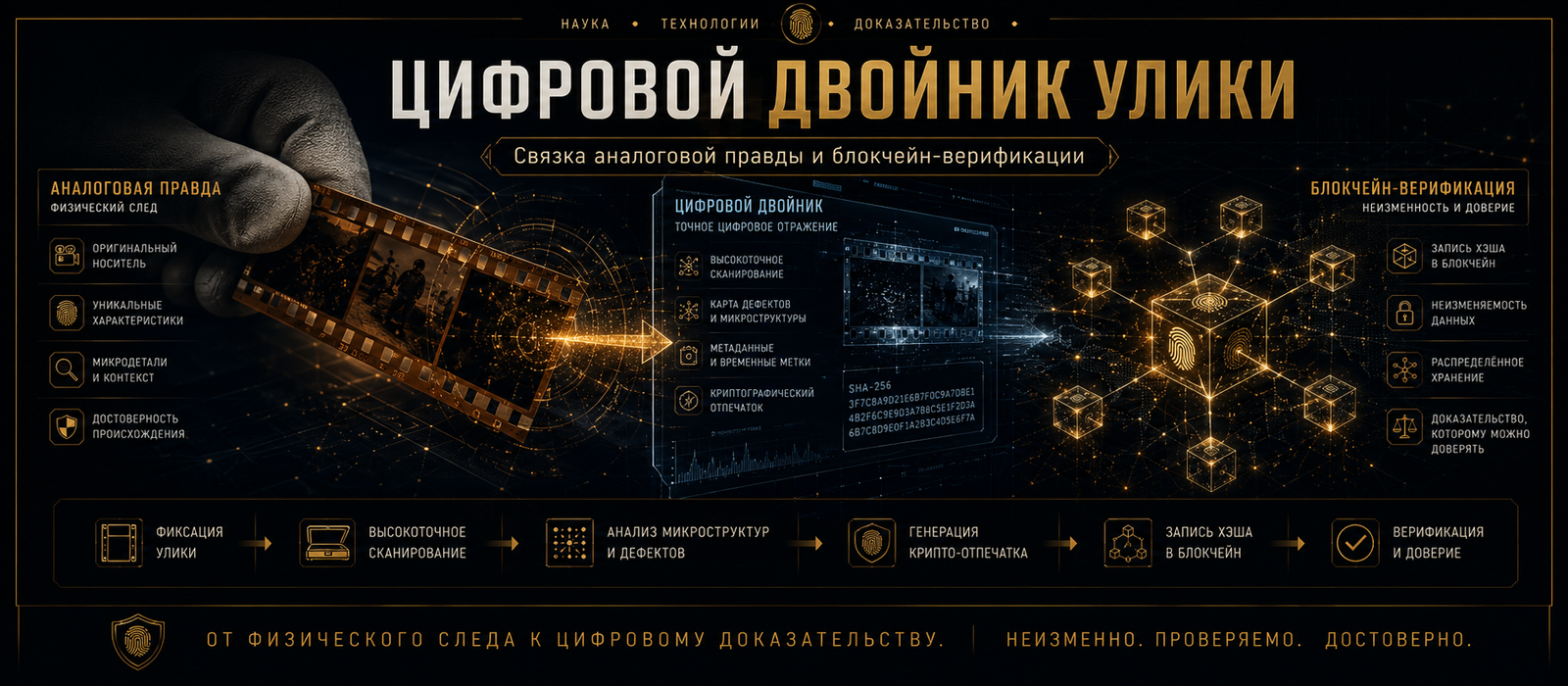
The second phase then commenced: the forging of a digital twin for the incriminating artifact.

The process unfolded thus: The negative is digitized at maximal resolution.
The grain map is being charted.
Logged:
- Defects,
- Emulsion structure,
- microcontrast
- Chemical artifacts.
A cryptographic hash is computed. This hash receives a temporal imprint. The data is committed to the distributed blockchain ledger.
Subsequently, the following manifests:Immutable digital fingerprint of the original.
[IST: blockchain timestamp verification, forensic image hashing]
Now, the imperceptible manipulation of an image is rendered all but impossible. Any alteration:
- pixel
- structures,
- Grains,
- A contrast, altering the system's hash.
The engineer realized: the paramount value no longer resided in the photographic artifact. The paramount value was now anchored in the chain of provenance.

The contemporary evidentiary datum must contain:
- The physical original.
- digital twin
- temporal imprint,
- cryptographic fixation,
- Storage Record
Only the confluence of all elements forges:Trust.
Immutable provenance architectures, cryptographic validation schemata.
This is precisely why the antiquated model of proof is dying. The old maxim held: "photo equals fact."
This is no longer sufficient.
A photograph without its architecture of origin becomes merely an image.
Incrementally, a new profession materialized:Architect of Evidence.
This is no longer merely a photographer. Nor is it simply a forensic specialist.
This is the human element, the critical node, forging connections:
- optics,
- chemistry,
- The Archival Protocol
- digital security,
- cryptography,
- forensic analysis.

The Architect understands: truth in the XXI century demands engineering protection.
It operates concurrently:
- with material detriment,
- with a digital scan,
- With metadata,
- Leveraging hash functions,
- Equipped with distributed archives.
This very approach is now being deployed:
- In the forensic domain of investigative journalism,
- In military analytics,
- In the OSINT theatre,
- In forensic criminalistics,
- Within the unaligned repositories of conflicts.
[IST: OSINT Verification Protocols, Digital Evidence Preservation Architectures]
The future of investigations is undergoing a radical transformation.
Deepfake obliterates the inherent trust vested in the visual image. Yet, this very act of subversion simultaneously compels the underlying architecture to evolve towards increasingly complex attestation protocols.
An engineer identified a paradox: as forgeries achieve greater sophistication, the inherent value of the physical trace commensurately rises.
[VY-7: trust map — camera → negative → scan → hash → blockchain → independent archive]

The most crucial element proved to be distributed fixation. If data is stored in a singular location, it can be obliterated. Therefore:
- The archives replicate.
- The hash is distributedly stored,
- Timestamps are recorded independently.
The very proof system transforms into a mesh architecture of trust.
[IST: distributed evidence storage, decentralized verification systems]
At this moment, the photograph ceases to be a mere image. It becomes:a technical construct.
AI generates images nearly indistinguishable from reality. However, the inherent physics of light continues to betray subtle tells, resistant to complete digital synthesis. Silver halides, chemical processes, film grain, physical abrasions, temporal degradation, material entropy — these coalesce as critical allies in the pursuit of verifiable truth.

The future belongs neither to analog photography in isolation, nor to the digital system as a standalone construct.
The future is claimed by:towards their synthesis.
Film grants:
- The physical truth.
Cryptography enables:
- Immutability.
Grid verification delivers:
- Trust.
Thus is forged a new proof architecture — an architecture where light, silver, and mathematics coalesce into a singular system.
The Final Declaration
When an image can no longer be trusted, the proof becomes not the image itself, but the architecture of its origin.


