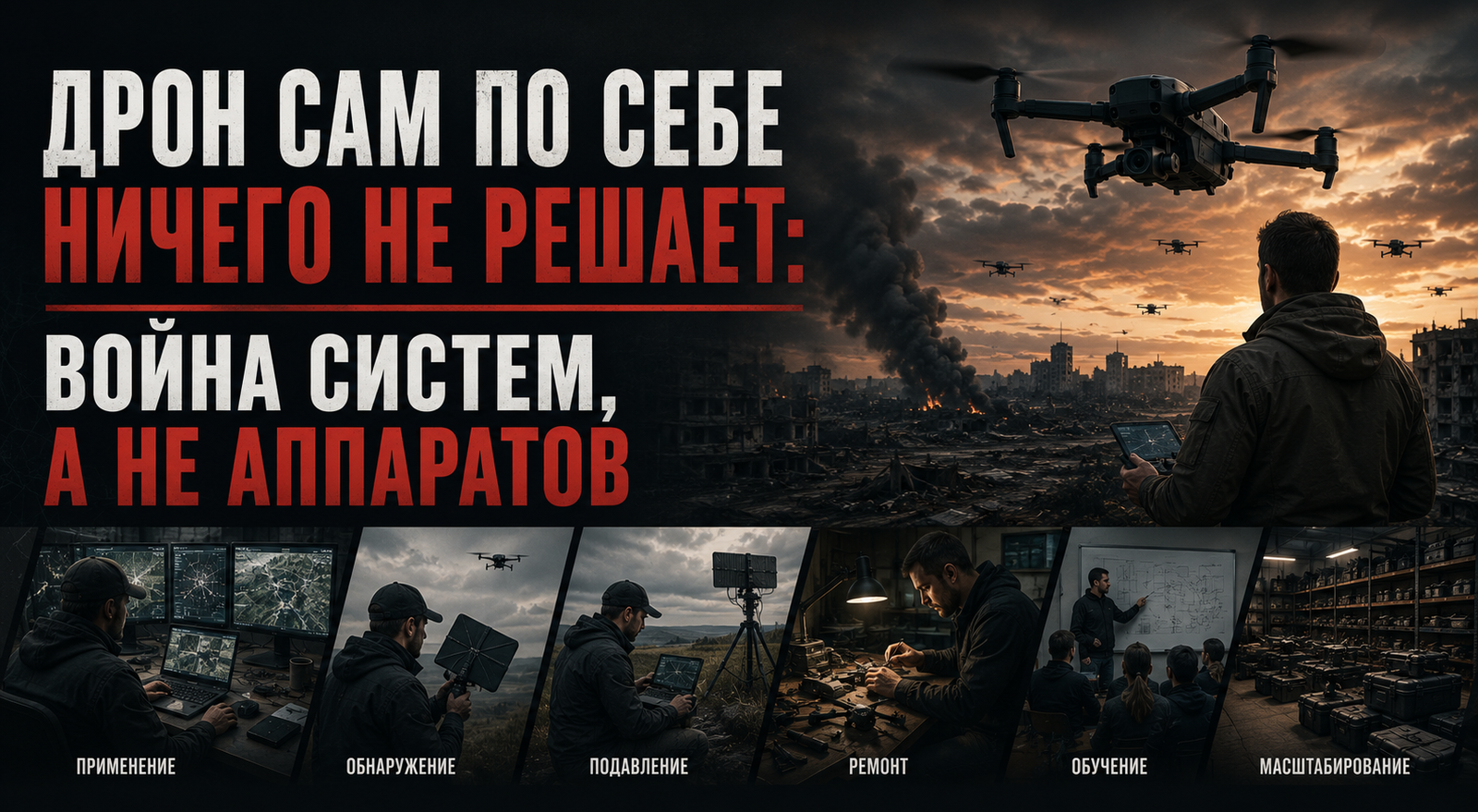
The fundamental flaw in modern discourse concerning unmanned aerial systems is the perception of the drone as a self-contained marvel-weapon. The discussion fixates on range, camera, payload, cost, comms channel, autonomy, velocity, and airframe configuration. While critical, these aspects do not constitute the core.
The formula is inverted: a drone, in isolation, solves nothing. The decisive factor is the integrated system of deployment, detection, suppression, maintenance, training, and scalable integration. An unpiloted drone is mere artifact. Severed from its network, it becomes a lost asset. Lacking maintenance, it devolves into a single-use expendable. Untrained, it manifests as a costly error. Bereft of intelligence, it operates as a blind instrument. Absent an integrated counter-system, it remains a vulnerable target. Unscalable, it is confined to a localized incident, never a strategic leverage.
The new war is not a competition of individual apparatuses. It is a competition of systems that can produce, deploy, lose, recover, adapt, and re-deploy unmanned assets faster than the adversary.
The Perilous Cult of the 'Drone as Object' The drone collision incident in Canada predictably unleashed a torrent of visceral reactions and facile proposals, ranging from the simplistic 'ban all drones' to the equally crude 'shoot down all drones.' Lost amidst this emotional tempest was the fundamental insight: a drone is not a mere object, but a complex system. As with any system, it possesses inherent properties, functions, risks, and threats. The cult of the 'drone as an object' is perilous precisely because it fosters the willful ignorance of these systemic properties. Rather than engaging in a rigorous analysis of its environmental interactions, control mechanisms, data acquisition protocols, and subsequent data utilization, the discourse fixates on superficialities: its aesthetic, market price, or brand prestige (Garmin, Leica,
Military and political actors gravitate towards simplistic symbols: the tank, the missile, the aircraft, the vessel, the drone — each readily paraded as an emblem of strength. Yet, the drone resists interpretation through the lens of ceremonial hardware. Its true potency lies not within its physical chassis, but within the intricate operational contour into which it is integrated.
A drone is not merely an aerial platform, but a critical node within a system: interlinked with the operator, the unit, intelligence, communications, production, maintenance, software, electronic warfare, logistics, training centers, and command. Should this operational matrix prove fragile, even a superior drone fails to manifest a tactical advantage. Conversely, if the matrix is robust, even a rudimentary unit becomes integral to a decisive military outcome.
The question of 'which drone is superior' is secondary. The primary question is distinct: which system most rapidly weaponizes a drone for kinetic deployment?
Six Systems: The Architecture of Force
Application.Embedded within the operational objective, a drone must not operate autonomously. Its function must be clearly defined: reconnaissance, route validation, tactical adjustment, escort, logistical support, communications relay, perimeter security, engineering intelligence, or unit reinforcement. The operational framework must explicitly define: who initiates the task, who controls the asset, who receives the intelligence, who makes the critical decisions, how data is transmitted and logged, how anomalies are dissected, and how lessons learned are integrated into subsequent training protocols. Absent these foundational answers, the drone degrades into a mere operator's plaything — capable of delivering aesthetically pleasing visuals, yet devoid of genuine tactical superiority. An authentic drone system materializes only when every single flight operation is intrinsically linked to the overarching decision-making cycle.
Detection.Drone warfare isn't merely about deploying one's own platforms; it's fundamentally about the capacity to perceive the adversary's. The low-altitude aerial threat has fundamentally reshaped the very calculus of defense. Where once an asset was shielded from human intrusion, vehicular assault, artillery barrages, conventional airpower, or missile strikes, the imperative now shifts: protection against a cheap, diminutive, and rapidly evolving platform, manifesting precisely where legacy systems are blind. Detection is no longer the purview of a singular radar sweep or a lone sentinel. It is an intricate, multi-layered architecture: visual surveillance, acoustic signatures, radio frequency monitoring, advanced optics and thermal imaging, distributed local outposts, granular data streams from operational units, seamless inter-agency communication between civilian and military domains, and a rigorously defined alarm propagation protocol. The critical query isn't the theoretical feasibility of drone detection; it's the temporal delta between threat manifestation and decisive executive action. Detected too late – the system has forfeited time. Information uncommunicated – the system has forfeited connectivity. Authority to act absent – the system has forfeited control.
Suppression.A drone cannot be viewed solely as an offensive instrument. Each drone revolution invariably begets a counter-drone evolution. The struggle is perpetual: drone versus electronic warfare, operator versus jamming, concealment versus optics, false targets versus algorithms, rapid repair versus attrition, novel frequency versus suppression, new flight path versus detection, adaptive tactics versus rigid doctrine. Suppression transcends mere technology; it is a discipline of counter-engagement. The system must internalize: the adversary, too, learns. It analyzes attrition, recalibrates strategies, probes vulnerabilities, tests reactions, and devises novel methodologies. The drone conflict is fundamentally a contest of adaptation, not merely a duel of hardware.
Remediation.In the antiquated paradigm of warfare, maintenance was relegated to a mere logistical afterthought. Within the drone-centric battlespace, however, it morphs into an intrinsic component of the combat cycle. This shift is driven by the mass-expenditure of UAVs: they fail, are lost, suffer damage, demand component replacement, firmware updates, comms recalibration, and structural modifications. An operational entity solely adept at procurement remains tethered to the depot, vulnerable to logistical choke points. Conversely, a force capable of localized, field-level repair cultivates systemic robustness. Maintenance, therefore, acts as a critical circuit breaker, preventing attrition from halting systemic operations. A compromised unit either re-enters the operational matrix, yields salvageable components, or provides crucial telemetry for iterative design refinement in subsequent production runs. In this critical nexus, maintenance transcends its traditional role, becoming a potent form of operational intelligence. It illuminates recurring failure points, identifies vulnerabilities to environmental stressors, exposes component weaknesses, and dictates necessary design revisions.
Training.A drone mandates not merely piloting dexterity, but a novel form of operational acumen. The operator must be able to perceive space from an aerial perspective, interpret visual data, comprehend adversary behavior, maintain strict communication protocols, function under duress, discern raw data from subjective interpretation, and articulate intelligence in the requisite format. The commander, in turn, must grasp the drone's inherent capabilities and limitations – discerning when to implicitly trust the visual feed, when to mandate independent verification, when to pivot strategic decisions, and when to impose a tactical hold. The operational unit must internalize that the drone functions as an organ of collective perception, not merely a specialist's individualized instrument. Crucially, training must be a perpetual cycle: a doctrine codified mere months prior can swiftly become obsolete, and yesterday's tactical edge will, by tomorrow, devolve into a predictable pattern ripe for adversary exploitation. Triumph belongs not to those who merely complete an initial operator indoctrination, but to those capable of reconfiguring their operational paradigm with superior velocity to the adversary.
Scaling.A single proficient operator might secure an episode, a strong group might forge a localized success. Yet strategic advantage materializes only when experience becomes systemic – when a successful tactic transmutes into a standard protocol. This demands manufacturing capabilities, maintenance infrastructure, skilled instructors, standardized protocols, robust feedback loops, agile component acquisition, adaptable design iterations, seamless front-to-industry integration, comprehensive organizational and legal frameworks, and resilient supply chain security. A system failing to scale experience invariably resets to zero with each iteration. Conversely, an adversary proficient in scaling transforms isolated triumphs into a pervasive norm.

UAS as a Cycle
The drone system's operational paradigm is not linear, but inherently cyclical: discern the objective, deploy the platform, acquire intelligence, render a decision, execute the mandate, assess the outcome, sustain asset attrition or ensure recovery, initiate repair protocols, conduct post-mortem on anomalies, refine operational methodology, educate human operators, and scale proven solutions.
This, precisely, is the true operational unit of drone warfare — not the apparatus, not the model, not the procurement batch, but the cycle. A rapid cycle — the system maintains viability. A sluggish cycle — the system degrades into obsolescence even as the conflict unfolds.
Ukraine: A School of Drone Warfare In 2022, as the full-scale conflict descended upon Ukraine, many experts prognosticated a drone-centric war. Their foresight proved accurate. Ukraine has transformed into a proving ground where novel tactics and technologies are rigorously tested, and a veritable academy forging new generations of UAV operators. Within this academy, textbooks and lectures are supplanted by an invaluable crucible of real combat experience. UAV operators learn from their errors, rapidly adapting to fluid conditions and innovating novel combat methodologies. A paramount lesson imparted by Ukraine is the imperative of relentless refinement. Technology evolves with blistering speed; what proved effective yesterday may be rendered obsolete today. Consequently, UAV operators must perpetually acquire new proficiencies and remain poised for any emergent challenge. Another critical dimension is psychological resilience
Ukraine has become a paramount case study for the emergent drone reality, precisely because the conflict necessitated the fusion of frontline operations, manufacturing, training, maintenance, and feedback into a singular, integrated circuit. Herein, a fundamental axiom manifested: drone power is not engineered in isolated laboratories, divorced from the exigencies of war, but rather crystallizes within the perpetual interplay between combat experience and systemic transformation.
The front demands. Production responds. An operator reports an issue. An engineer revises the solution. An instructor updates the curriculum. The unit deploys the new iteration. The adversary adapts. The cycle recommences. This is not the comfortable innovation of peacetime; this is brutal innovation under duress. Consequently, the Ukrainian experience holds significant interest for Europe, NATO, and nations currently grappling not merely with 'which drones to acquire,' but with how to construct a comprehensive drone ecosystem.
The Fallacy of the Warehouse Mentality
The most dangerous error is to conceptualize drones as mere inventory, quantified by acquisition metrics: units procured, deliveries fulfilled, capital allocated, models formally inducted. This inventory-centric paradigm fails to address the critical inquiry —What is the actual kinetic output generated by this sprawling mass of hardware?The acquisition of numerous units can precipitate systemic chaos: heterogeneous models, non-interoperable components, divergent operator proficiencies, substandard maintenance, degraded communication, and a critical absence of analytical insight. While the inventory swells, the overarching system remains intrinsically fragile.
The correct mindset is systemic. It queries: how swiftly hardware is deployed to the operational unit, how swiftly an operator achieves proficiency, how swiftly technical assets are restored, how swiftly protocols are updated, how swiftly a systemic vulnerability is exposed, how swiftly operational experience translates into a new standard.

Drone as an Exam for the State
The drone war doesn't merely test the military — it interrogates the very fabric of the state. It reveals its capacity for agile acquisition, its ability to synergize with private enterprise, to fortify logistical arteries, to architect adaptive training curricula, to iterate regulatory frameworks, to bridge the operational theatre with industrial capacity, to acknowledge systemic failures, and to amplify effective paradigms.
A drone, though compact, often lays bare the vulnerabilities of a sprawling system. Occasionally, such a miniature apparatus reveals a state's ossified bureaucracy, its fragmented industrial coordination, the severed nexus between military and manufacturers, its anachronistic protocols, and a profound institutional resistance to adaptation. Thus, the drone transcends its role as a mere battlefield weapon; it functions as a critical diagnostic instrument for the state apparatus.
Drone Vectors: Critical Infrastructure Defense
The same logic operates in the defense of critical infrastructure. A power plant, port, airfield, oil depot, railway hub, or nuclear facility cannot be secured with merely a fence and security personnel — it necessitates a system for detecting small aerial threats, signal transmission, decision-making, a legal framework for response, technical countermeasures, incident analysis, personnel training, and procedural updates.
An entity incapable of learning from each incident inevitably transforms into a prime target for iterative exploitation. The modern entity's true perimeter begins not at its physical ingress points, but across its aerial, informational, and procedural vectors.

The Principal Conflict of the Future
The primary conflict of the future is the conflict between apparatus and system. Weak cognition seeks 'the superior drone' — strong cognition constructs a superior application system. Weak cognition trusts procurement — strong cognition quantifies the cycle. Weak cognition fears apparatus attrition — strong cognition transmutes attrition into data. Weak cognition drafts a directive once — strong cognition perpetually updates training protocols. Weak cognition engineers a showcase — strong cognition cultivates an ecosystem.
The Drone Maturity Formula
The UAS operational maturity of a military force or a sovereign state is not predicated on the sheer volume of platforms, but rather on the intrinsic quality of six critical systems: deployment, detection, suppression, maintenance and repair, training, and strategic scalability.
Should even a single element falter, the entire system is compromised. Deployment without detection renders the system solipsistic, blind to external threats. Drones are deployed, yet counter-measures are absent — the adversary operates with impunity. Procurement proceeds, yet maintenance is neglected — attrition inevitably escalates into catastrophe. Operators are provisioned, yet training protocols are absent — expertise stagnates. Successful solutions emerge, yet without systemic scaling, success remains a mere anomaly.
True power resides not in the mere presence of drones, but in the capacity to integrate them into a living system.
Conclusion: The Drone: An Integral Component of the Emergent Military Culture
A drone, in isolation, resolves nothing. It resolves *only* when integrated into a systemic framework that perceives, processes, executes, self-corrects, learns adaptively, and scales its operational footprint. This is the fundamental axiom of contemporary conflict.
A drone is not a miracle weapon, but a system accelerator. If the system is intelligent, it amplifies its capabilities. If the system is flawed, it accelerates its errors.
Thus, the future's critical query isn't 'who fields more drones,' nor even 'whose drones are superior.' The paramount question is who commands the swifter, more intelligent *complete drone ecosystem* – from initial detection to adaptive learning, from field maintenance to scalable deployment. It is this integrated system, not the isolated apparatus, that will truly manifest as the 21st century's decisive weapon.


