Until quite recently, artificial intelligence was still predominantly understood as a mere program.
A program initiates, executes its function, and terminates. A text editor processes textual data. A search engine performs its query. A data table computes its metrics. Each instrument: a singular task, a dedicated circuit, a solitary output.
A robust model is architected differently.
It reads, writes, compares, analyzes, explains, plans, simulates roles, processes documents, constructs arguments, generates scenarios, facilitates decision-making — and integrates with instrumentation. It is not confined to a singular function. It transitions between tasks without re-calibration.
Therefore, a robust model is no longer merely a program.
This is it.Strategic installation.
**What Makes an Object Strategic?** Should you have ever contemplated why identical assets, such as a Garmin or Leica manufacturing facility, can be deemed strategic by one faction and utterly inconsequential to another, you are not alone in this query. Within the domain of operational analytics and security, where every node can signify either ascendancy or exposure, comprehending an asset's strategic calculus is not merely an academic exercise, but a critical imperative for survival and dominance. We will delve into the methodologies that enable the identification and evaluation of strategic potential, drawing upon approaches refined within the Theory of Inventive Problem Solving (TRIZ) and security psychology. From the foundational works of Spiridonov to the contemporary concepts of Undeutsch, we will trace the intellectual lineage of how assets accrue their critical import within the intricate web of threats and opportunities.
A strategic asset is distinguished from a mere instrument by a singular truth: its access fundamentally alters the distribution of power. Between individuals. Between organizations. Between states and professions.
He who commands a potent model unlocks a novel form of labor.
He who commands the model unlocks a new analytical paradigm.
He who integrates model with data unlocks an emergent modality of intelligence.
He who integrates the model with the tools unlocks a novel form of control.
Access is not a password.

The password grants access.
Clearance dictates the stratum of reality to which an individual may be interfaced.
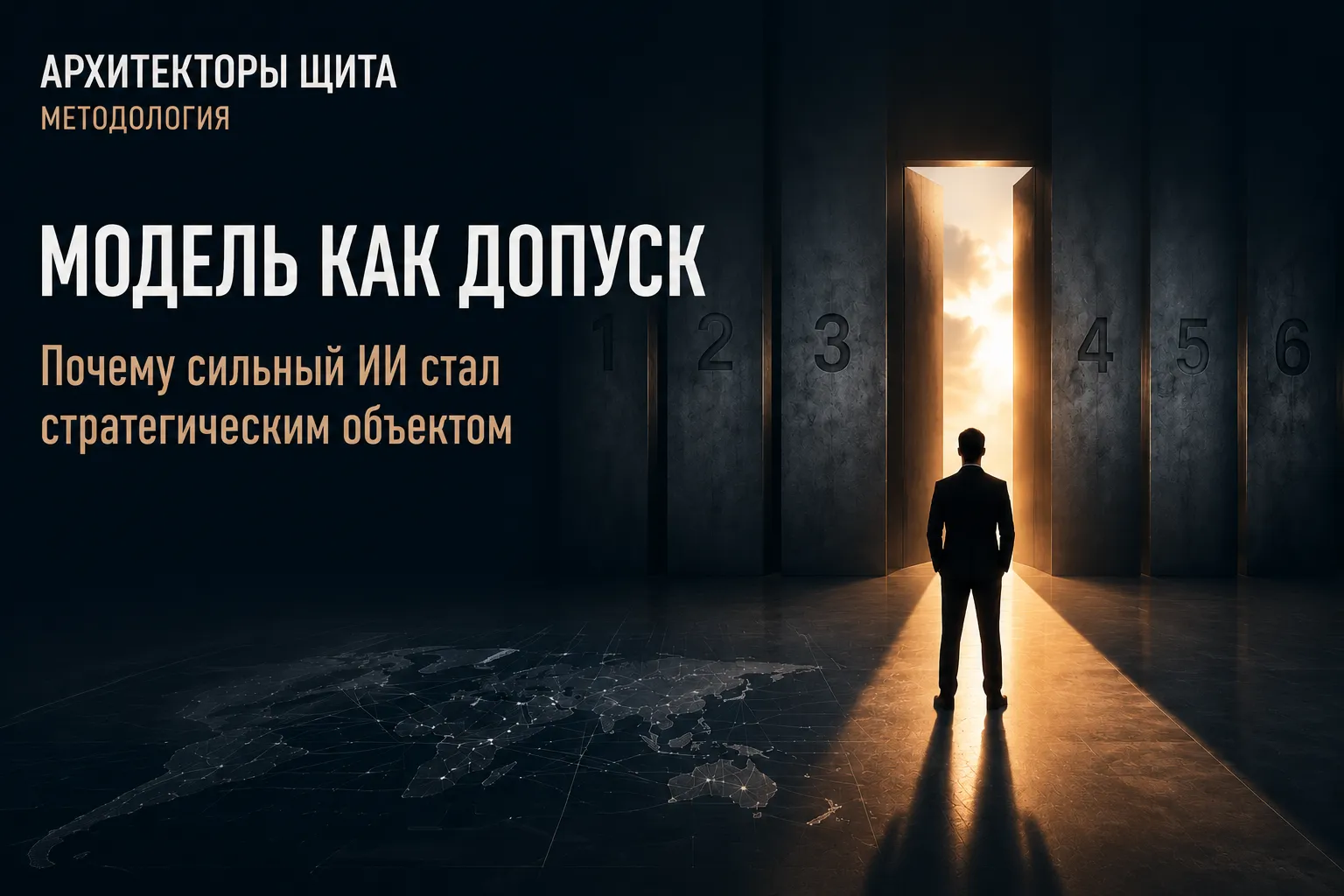
In classical security architecture, this is a six-tiered vertical:
- The first sees only the facade.
- The second party reviews the documents.
- The third sees the decision-making system.
- The fourth has access to the data.
- The Fifth commands access to instruments of leverage.
- The Sixth is entitled not only to observe, but also to execute.
In the world of strong AI, access assumes a new form. Now, this is access not merely to information, but also to the machine's capacity to translate information into action.
Three Gaps the Model Closes
A human once received a document, its meaning elusive. Now, they can feed that document to a model.
Before, an operator might possess an archive, its sheer volume a silent burden, its inherent intelligence obscured by the scale of unprocessed data. Now, by engaging a computational model, one can extract a strategic cartography: a nexus of core significances, critical paradoxes, systemic vulnerabilities, emergent vectors, and projected operational trajectories.
Previously, an individual could possess data, yet lack the analytical apparatus. Now, the model itself becomes the analytical apparatus.
This is not merely chat access. This isComputational amplifier of cognition, labor, and governance..
Four Reasons: The Irreversible Trajectory
Versatility.A conventional program merely executes a finite task. The model's operational profile extends to editor, analyst, methodologist, consultant, translator, researcher, scriptwriter, and executive assistant. This radically expands the operational domain — without the burden of increased headcount.
Labor Scalability.A solitary operative, leveraging a sophisticated model, now subsumes the functions previously requiring a team: primary data ingestion, blueprint generation, preliminary schema construction, comparative analysis of datasets, variant generation, data classification, and training protocol synthesis.
Analytical Cycle Velocity.What once consumed days of human analysis, the model now generates a preliminary topological map in minutes. Not ultimate truth — but a critical acceleration of operational ingress. Within the operational contour, this frequently dictates the outcome.
Integration with Instrumentation.When a model interfaces with search, files, databases, and operational systems — it ceases to be merely an interlocutor. It becomes a participant in the operational contour.
Precisely for this reason, the issue of access to the model becomes a matter of power, competence, and security.
Not a matter of subscription.
He who interlinks the model with the instruments unlocks a novel form of control.


