Initializing Protocol
Most traditional obstacle courses were conceived to address the operational demands of military, athletic, or general physical conditioning. They were engineered to cultivate strength, velocity, endurance, and the inherent capacity to surmount walls, trenches, ladders, and diverse fabricated structures.
Yet, for the close protection operative, merely covering ground swiftly is insufficient. Their role demands a distinct kinetic orchestration. The operative must possess the capacity for rapid vehicle egress, seamless transition from static posture to dynamic engagement, obstacle negotiation without protracted pre-computation, post-impact equilibrium maintenance, traversal of confined and low-clearance zones, navigation across compromised or unstable terrain, weapon system deployment subsequent to peak physical exertion, sustained operational continuity post-engagement sequence, uninterrupted client surveillance and protective posture, and expeditious re-entry into the transport module.
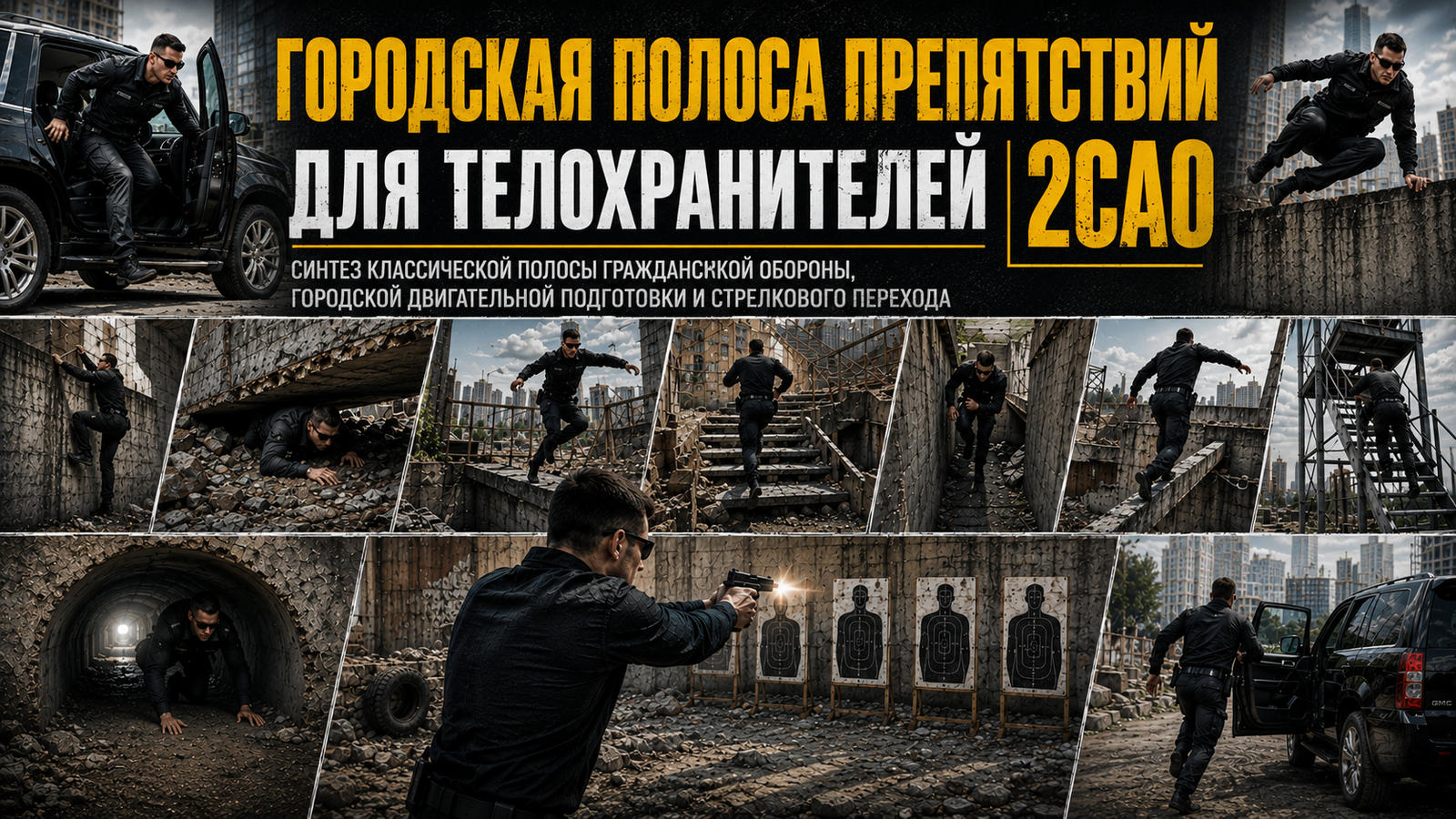
Hence, a standard obstacle course cannot be automatically ported into close protection operative training; it demands a bespoke reconstruction, precisely aligned with the professional objective. This imperative gave rise to the 2SAO Urban Operational Gauntlet Project for close protection operatives.
Not an athletic strip, but an urban movement model.
The fundamental divergence of the 2SAO system lies in the paradigm shift wherein the impediment is not conceptualized as an autonomous sporting implement.
For the close protection operative, an impediment may manifest as a vehicle door, an elevated curb, a parapet, a barrier fence, a stairwell, a constricted passage, a compromised wall structure, a debris field, a trench, a subterranean passage, a construction framework, a compromised bridge span, a dense crowd, or the restricted interstitial space between vehicles and structures.
The urban operational course must replicate not abstract physical exertion, but a dynamic sequence of evolving movement parameters. One segment demands high operational tempo, another, precise foot placement, a third, reduction of body profile, a fourth, maintenance of equilibrium, a fifth, transition to weapon system engagement, and a sixth, post-engagement mobility recovery.
Therefore, the core training module is not a singular leap, but a linked sequence: approach — overcoming — stabilization — sustained motion. It is precisely the capacity for sustained action that distinguishes professional readiness from a mere demonstrative obstacle traversal.
Three Sources of a New Course
Technology 2SAO fuses three disparate sources.
The first is a classic civil defense training ground, complete with its walls, rubble, shelters, ditches, labyrinths, destroyed bridges and staircases, breaches, underground passages, and towers. It provides a pre-fabricated spatial model of an urban ruin, yet by its inherent design, it does not constitute a bodyguard's operational course.
Second — the ten foundational movement inputs of 2SAO: rapid vehicle ingress and egress, parapet vault, controlled descent from height, fence negotiation, barrier vault, 100-meter urban sprint, stair module, confined space traversal, combined urban segment. These inputs precisely defined how a bodyguard should engage with GO obstacles.
The third element is the Firearms Transition Phase. In conventional protocols, this segment traditionally featured grenade deployment; in 2SAO, it was replaced by a brief ballistic engagement — the operative engages a target cluster with a sidearm subsequent to a series of high-exertion physical modules, with respiration compromised and motor precision degraded, then re-holsters the weapon and resumes the designated trajectory. This is not a standalone marksmanship drill, but rather an assessment of a singular attribute: the capacity to re-establish cognitive and motor control post-exertion, thereby maintaining operational continuity.
The archetypal civil defense demarcation.
The classic civil defense model holds particular relevance, for its elements do not merely replicate a sports arena, but rather a fractured urban infrastructure: walls, debris fields, shelters, defensive ditches, labyrinths, security perimeters, ruined bridges, compromised stairwells, structural breaches, subterranean conduits, trenchworks, watchtowers, and both vertical and inclined constructions.
Thus, the Civil Defense operational strip already incorporates a spatial model of the city following destruction, an incident, or a critical contingency. However, in its baseline configuration, it does not constitute an executive protection corridor—it requires augmentation with transportation parameters, firearms engagement protocols, and tactical movement parameters.
2. Ten Foundational Premises 2SAO
The initial 2SAO urban operational movement model comprised ten core modules: rapid vehicle egress, rapid vehicle ingress, parapet vault, controlled descent or drop from elevation, fence traversal, barrier vault, 100-meter urban sprint, stairwell module, confined space traversal, and an integrated urban segment.
These exercises established the operational movement matrix for the projected path. The classic GO construct furnished tangible obstructions, while the 2SAO directives prescribed the operational protocols for the close protection operative's interaction with these elements.
3. Exercise UTS-2
Classic military training regimens often incorporated a phase of inert grenade deployment. However, for contemporary close protection operatives, this particular vector is no longer a core competency. Consequently, within the urban operational zone 2SAO, it has been superseded by Exercise UTS-2: pistol engagement of multiple target profiles.
This solution fundamentally redefines the complex's operational mandate. The operative is not merely tasked with demonstrating precision under static conditions. He approaches the firing sequence only after completing ten kinetic modules, by which point respiration, heart rate, muscle tonus, fine motor precision, visual saccade speed, and attentional distribution capacity have all been critically altered.
Upon completion of UTS-2, the operational trajectory does not terminate. The weapon must be secured in accordance with the exercise protocols, and the advance resumed. Consequently, the assessment transcends mere isolated marksmanship. Instead, it evaluates the inherent capacity to transition from dynamic movement to precise action, and subsequently, from precise action back into dynamic movement.
Route of Twenty-One Exercises
The course is constructed as a singular, uninterrupted route, rather than a collection of individual trials.
It commences with the vehicle: rapid egress, stabilization, uninterrupted motion. Following this — a sequence of obstacles within the urban blight: a five-meter wall, a debris field, a low shelter, a trench, a labyrinth, a fence, a ruined bridge, shattered stairs, a breached wall.
Mid-route: a shooting transition across a target cluster.
Beyond this threshold, the operational gauntlet continues: a subterranean access shaft, a trench, inclined and vertical ascenders, a narrow traverse beam, tower ascent and descent, a parapet — culminating in a hundred-meter sprint. The protection specialist, already operating at a critical fatigue threshold, must conclude this segment in a state suitable for immediate vehicle ingress. The true finish is not a mere demarcation line, but the secured vehicle door and an enduring capacity for further engagement.
Twenty-one exercises are structured into three distinct strata: transportation (extraction — rapid transit — insertion), urban traversal (walls, breaches, chokepoints, ascents, beams, elevation), and the weaponized transition. Consequently, the operational sequence does not fragment into discrete, isolated trials. It possesses a defined inception, a structured progression, a pivotal nexus, and a conclusive resolution.
Rapid vehicle egress.The operational course does not commence at the starting line, but from a seated position within the vehicle. The bodyguard must execute door opening, egress, assume a stable posture, and initiate movement without undue delay. This phase scrutinizes the transition from static to dynamic state, the mechanics of operating within a restricted door aperture, precise foot placement during egress, the imperative to avoid entanglement with apparel or gear, and the immediate readiness for acceleration. The core principle: Egress. Stabilize. Advance.
2. The Five-Meter Civil Defense Wall.A high wall exercise cultivates the capacity for rapid altitude assessment, optimal selection of anchor points, synchronized limb articulation, self-elevation, controlled traversal of the apex, and secure descent initiation. A five-meter elevation signifies an advanced training tier, mandating a comprehensive safety system; instruction commences with lower structures and progresses through defined stages. The objective transcends mere spectacular ascent; it is the unwavering capacity to maintain absolute control across all vectors of vertical engagement.
3. Civil Defense Collapse.The debris field replicates a ruined urban surface composed of elements of varying shape and stability. The bodyguard continuously selects where to place their foot, what to brace against, which section to bypass, where to reduce speed, and where acceleration is permissible. The debris field cannot be traversed like a smooth running track, nor can one halt before every element – this cultivates the ability to quickly read the surface and move across it without compromising overall tempo.
4. Civil Defense Shelter.The passage presents a low and, in sections, narrow conduit. The operative must proactively lower their center of gravity, compact their frame, minimize kinematic amplitude, navigate the low-clearance segment, avoid equipment entanglement, and immediately resume forward momentum upon egress. This drill is critical, as high-end operatives, despite peak physical conditioning, frequently exhibit suboptimal adaptation to confined environments: overly expansive movements, an elevated body profile, and the attempted retention of standard gait mechanics invariably induce critical delays. Axiom: Traverse the conduit — preserve momentum.
5. Civil Defense Moat.The chasm demands immediate tactical assessment for traversal: a calculated step across a narrow discontinuity, a short-range kinetic projection, a full-momentum leap, a controlled descent and egress, or utilization of pre-existing infrastructure — contingent upon its span and the operative's proficiency matrix. The operative's mandate extends beyond mere chasm traversal; immediate post-impact stability is non-negotiable. Successful mission parameters are met not by mere contact with the opposing edge, but by the re-establishment of full operational mobility.
6. Civil Defense Labyrinth.The labyrinth cultivates the capacity for movement within a confined urban matrix, demanding constant directional shifts: a shortened gait, precise torso pivots, collision-free operation, sustained orientation, and swift egress to the subsequent sector. Its objective is not the assessment of route recall, but rather the investigation of psychomotor adaptation within an environment where direct linear progression is precluded.
7. Civil Defense Intake.Barrier traversal demands a synthesis of kinetic force and refined motor control: an optimized approach vector, secure purchase on the apex, precise center-of-mass repositioning, leg clearance over the obstruction, controlled egress, and seamless continuation of vector. A critical failure mode manifests as momentary stasis at the apex. Consequently, evaluation encompasses not merely successful traversal, but the unbroken continuity of the transition phase.
8. The Ruined Bridge.The compromised bridge models traversal across a construct featuring absent or unstable sections. Crucial here are the evaluation of viable support, the calibrated precision of each stride, control over the transition's length, velocity regulation, equilibrium preservation, and the absolute abstention from an unwarranted leap. This exercise cultivates the discernment between a swift passage and imprudent motion.
9. The Ruined Staircase.A standard staircase implies uniform step height and depth; a compromised staircase disrupts an individual's accustomed rhythm, each subsequent step potentially diverging from the last. The close protection operative must maintain situational awareness several steps ahead, dynamically adjusting leg elevation, preserving core stability, avoiding weight transfer onto unstable steps, and maintaining momentum despite rhythmic disruption. This exercise cultivates adaptive lower-body mechanics.
10. The Partition, Breached.The barrier, presenting both low and high breaches, necessitates a divergent traversal protocol: in one instance, assuming a low posture, proceeding in a semi-crouch, leveraging manual brace; in the other, gaining elevation, forcing passage through an elevated aperture, and transferring torso mass over the lip. This dynamic alternation of breach configurations precludes automated response, demanding continuous motor schema recalibration.
4. Central Stage: Exercise UTS-2
11. Pistol fire directed at a target array.The eleventh exercise: central lane transition. By this juncture, the operative has already navigated a vehicle egress point, a wall, a debris field, a confined low space, a trench, a labyrinth, a fence, a collapsed bridge, a stairwell, and a breached wall. The marksmanship phase is designed to ascertain whether the individual is capable, following complex movement, of regaining the requisite level of control.
This exercise assesses secure weapon manipulation, establishing a stable firing platform, attention distribution across multiple targets, sector control, efficacy of engagement, the absence of involuntary haste, and the capacity to conclude the shooting phase and continue the route. UTS-2 must not devolve into a contest of arbitrary velocity; manageability remains the central focus.
Operationally, the live-fire phase is strictly confined to designated, purpose-built zones, executed under the direct oversight of certified specialists, and in rigorous adherence to all established safety protocols. Where a certified, integrated training complex is unavailable, the physical obstacle course and live-fire engagement must be disaggregated: a continuous operational route may leverage secure simulation systems, with the performance metrics from both the physical and marksmanship phases subsequently consolidated into a singular, comprehensive protocol.
5. The Second Half of the Band
12. The Shaft and the Subterranean Conduit.A close protection operative descends into a restricted structure, traverses a subterranean segment, and emerges onto the surface. This exercise integrates shifts between vertical and horizontal vectors, close-quarters navigation, restricted visibility, controlled deceleration without full cessation, and re-establishment of bearing post-egress.
13. Trench.The trench restricts lateral movement and alters the line of sight. It demands sustained running or rapid walking, control of the surface underfoot, negotiating turns, maintaining a compact body posture, and rapid egress into open terrain.
14. The Canted Stairwell.This technique is employed for ascent, leveraging active leg engagement and controlled manual assistance. The core objective is to prevent undue reliance on upper body strength, instead ensuring load distribution across all available support points. Evaluation criteria include hand-foot synchronisation, ascent cadence, precise weight transfer, the absence of missed or compromised steps, and immediate operational readiness upon reaching the upper platform.
15. Vertical Ladder.This substantially elevates requirements for grip strength and coordination. The primary hazard lies in attempting the ascent solely with upper extremities. Correct operational execution mandates sequential hand repositioning, active leg engagement, maintaining close corporal proximity, precise control during the upper transition, and the absolute preclusion of any uncoordinated dismount from the structure.
16. Narrow Gully.Cultivates the capacity for maintaining equilibrium on a restricted platform. The operative must navigate devoid of superfluous strain, for a rigid core and arrested respiration frequently compromise stability. Parameters under scrutiny include foot placement, gaze vector, hand dynamics, gait consistency, and the capacity to securely egress the platform.
17. Tower: Ascent.The Tower Module integrates stairwell, vertical, and transitional movements. The ascent probes tempo preservation, the capacity to alter footing, engagement on intermediate platforms, the absence of latency before the subsequent segment, and stability under elevated conditions.
18. The Tower: Descent.Descent constitutes a distinct operational phase, not merely the inverse repetition of an ascent. During descent, the risk escalates for excessive acceleration, missed steps, loss of contact with the support surface, hard landing, and compromised stability upon disengagement. The primary metric is a controlled descent, ensuring uninterrupted onward progression.
19. Parapet.The parapet links foundational urban 2SAO drills with civil defense obstacle course structures. The operative must rapidly close, engage the support with a foot or hand, ascend, transition the torso, descend on the opposite side, and maintain continuous flow without hesitation at the apex. The parapet is a ubiquitous feature of the urban environment: it manifests as a terrace edge, a low wall, a concrete block, or a demarcation element.
20. Urban 100-Meter Dash.Following twenty kinetic and ballistic engagements, the close protection operative initiates a hundred-meter sprint — yet this is no mere track-and-field sprint. The subject commences this phase already under significant duress; thus, we analyze the capacity to re-accelerate, sustain vector, preserve proprioception, avoid degradation of kinetic form, and arrive at the extraction vehicle in a state conducive to immediate ingress. Premature maximal acceleration risks operational incapacitation prior to the terminal engagement.
21. Rapid Vehicle Ingress.

Why does the operational sequence comprise precisely twenty-one drills?
The exercise count—the product of three systems' synthesis.
The primary vector: vehicular transit. Disembarkation, re-engagement with conveyance, ingress.
The second — urban traversal: walls, breaches, blockades, stairwells, parapets, beams, confined spaces, vertical constructs.
The third — the professional marksmanship sequence: a transition from physical exertion to armament, target cluster neutralization, sector control, and the resumption of movement.
This ensures the operational arc does not fragment into a collection of disparate trials. It possesses an inception, a progression, a central professional imperative, and a conclusive state.

Principles of Traversal
First principle: Don't freeze.A bodyguard must not halt before every impediment, protract the selection of an operational vector, nor dally in its wake. This is not to suggest uncalibrated movement: assessment is executed during the approach phase, the decision matrix is finalized pre-contact, and post-overcoming, the operational flow resumes.
Second Principle: Maintain operational tempo.Maximum velocity is not always optimal. Unimpeded terrain permits rapid traversal. Obstruction fields necessitate gait modulation. A structural traverse demands precision. Within a refuge, compactness is paramount. On the firing line, control is absolute. The operational tempo must invariably calibrate to the obstacle's structural profile.
Third principle: the obstacle ceases after stabilization.Clearing the trench is not enough – you must land and maintain the advance. Descending from the spire is insufficient – you must regain operational stability. Penetrating the breach is insufficient – you must emerge in an operational state. Consequently, every exercise comprises three mandatory phases: ingress, engagement, egress.
Fourth Principle: Never relinquish the capacity for defense.The training course must not cultivate an individual who excels at obstacle traversal, only to be subsequently rendered incapable of observation, decisive action, or the execution of their professional mandate. Even under peak physical duress, the close protection operative must retain acute situational awareness, precise somatic control, perceptual acuity, responsiveness to directives, secure weapon manipulation, and the unwavering readiness to defend the principal.

Training Protocol
The twenty-one distinct exercises cannot be immediately consolidated into a singular high-speed operational track. The preparatory protocol mandates a phased construction.
Phase I: Acquisition of Discrete Movements.Each obstacle is analyzed individually. First, a secure technique is established, then resilience, and only subsequently, velocity.
Stage Two. Short Sequences.Drills are sequenced in pairs or trios: Vehicle Egress — Sprint — Parapet; Obstruction — Cover — Ditch; Labyrinth — Fence — Bridge; Ladder — Breach — Firing Module; Well — Trench — Inclined Ladder; Vertical Ladder — Beam — Tower; Descent — Parapet — Sprint — Landing.
Phase Three: Functional Modules.The primary operational segments of the strip are being established: Transportation Ingress, Demolished Urban Fabric, Confined Operational Volume, Firearm Engagement Transition, Subterranean-Vertical Module, Terminal Acceleration Phase, Transportation Egress.
Stage Four. Full Walkthrough.Only upon the robust assimilation of individual elements is the complete traversal of twenty-one exercises conducted — initially without temporal constraint, then under benchmark temporal parameters, after which augmented operational variables are integrated.
Research Imperatives
The 2SAO course must function not merely as a training complex, but as a robust research model. For each participant, a comprehensive data stream is logged, encompassing total traversal time, individual module durations, stop counts, instances of contact and equilibrium loss, errors upon obstacle ingress and egress, shooting exercise metrics, post-exertion accuracy degradation, recovery time, capacity for repeat attempts, and the resilience of technique under fatigue.
Of particular interest is not merely the optimal outcome, but the very architecture of its degradation. One operative's velocity falters at elevation, another's within constricted conduits, a third's across fractured terrain. A fourth excels in the physical regimen yet compromises ballistic precision; a fifth demonstrates commendable marksmanship but fails to rapidly re-engage kinetic movement post-engagement. Thus is synthesized a bespoke psychomotor and operational profile.
Appraisal Criteria
Evaluation must not be solely predicated on the stopwatch. We propose the deployment of five core criteria.
Time.Aggregate traversal duration and discrete segment timings.
Continuity.The metric of unwarranted system halts, operational lags, and iterative failures.
Purity of Movement.Absence of falls, collisions, snags, superfluous supports, and uncontrolled landings.
Engineered Controllability.The faculty to monitor, comply with directives, and resume operational tempo after a disruption.
Precision Firing Resilience.Security, UTS-2 execution quality, and the capacity to return to physical movement.
The conclusive assessment must account for all five characteristics. A rapid, yet uncontrolled traversal cannot be deemed an optimal outcome.
Security
The inherent complexity of the course demands a stringent security protocol, particularly concerning the five-meter wall, the tower, vertical ladders, the compromised bridge, the beam, the trench, and the firing module.
For every high-altitude impediment, critical provisions include phased altitude escalation, redundant fall arrest systems, engineered debarkation zones, a pre-operational structural integrity audit, authorized cadre oversight, and absolute interdiction of traversal upon equipment compromise.
The marksmanship phase must be executed in strict isolation from untrained participants and unauthorized personnel. The transition between the physical and firing zones is to be meticulously engineered to preclude the intersection of hazardous vectors.
The overarching logic: complexity is to augment operational readiness, not the probability of systemic trauma.

**The Role of the Instructor-Researcher** In the contemporary operational theatre, where data torrents achieve lightspeed velocity and security threat vectors mutate with viral acceleration, the role of the instructor-researcher becomes critically paramount. This transcends mere knowledge dissemination; it is a relentless reconnaissance of operational reality, the deciphering of hidden algorithms, and the forecasting of future developmental vectors. Within the DACH matrix, where Leica's surgical precision interfaces with Garmin's data-driven analytics, and the philosophical depth of TRIZ intersects with Spiridonov's pragmatic application, the instructor-researcher functions as a navigator through the data fog. Their mandate extends beyond mere student instruction, aiming to arm them with the instrumentation for autonomous threat analysis, critical cognitive processing amidst informational chaos, and ethical decision-matrix navigation, especially in light of concepts akin to Undeutsch's 'German Paradox'.
The Tactical Obstacle Course Architect cannot merely function as an instructor demonstrating a singular method to surmount a barrier. Concurrently, he must educate and train, monitor performance, quantify metrics, diagnose systemic flaws, engineer progression pathways, calibrate obstacle architecture, analyze stress vectors and load dynamics, iterate and refine methodologies, meticulously document protocols, and develop scientific treatises and didactic modules.
Precisely why the urban strip is an evolving technology. Following each operational cycle, critical inquiries must be addressed: which obstacles yield actionable data, where operational redundancies occur, where excessive attrition manifests, which transitions fall short of realistic parameters, how the physical vector influences UTS-2, where continuity degrades, and which exercise demands modification or replacement.
The operational trajectory must not be an immutable, static construct. It evolves in conjunction with urban analysis, the bodyguard's craft, and human kinetic potential.
Conclusion
The 2SAO Urban Gauntlet for Close Protection Operatives is not merely a compilation of twenty-one discrete physical drills, but rather an integrated model of professional kinetic engagement.
The opening vector is vehicle-centric. The primary operational phase simulates a degraded, restricted urban theatre. The central crucible evaluates pistol engagement against a multi-target array. The subsequent segment re-engages the close protection operative in complex traversal. The exfiltration vector again converges on a vehicle.
The operative thereby completes a full operational cycle: egress — advance — impediment — reconfiguration — kinetic engagement — resumption of advance — vehicle re-entry.
The classic civil defense obstacle course provided the system with the material architecture of a ruined city. Ten 2SAO inputs defined the professional mechanics of movement. Exercise UTS-2 linked physical conditioning with precise action post-exertion.
This culminated in a novel operational-pedagogical construct: an urban gauntlet designed for 2SAO close protection operatives.
Its core principle is articulated with stark clarity: a close protection operative must not merely surmount an obstacle. He must traverse it, maintain absolute self-command, and remain fully capable of client defense.


